Georges Cziffra play Grieg & Liszt
Georges Cziffra (piano)
Orchestre National de l’ORTF, André Cluytens, Georges Tzipine
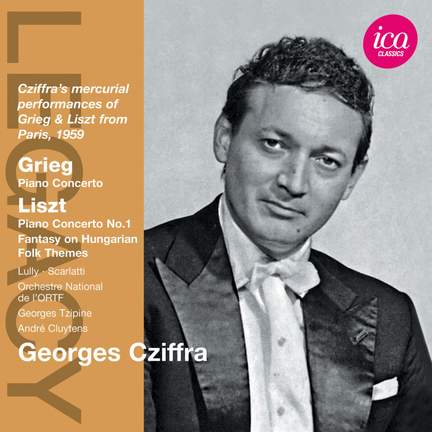
Georges Cziffra play Grieg & Liszt
Georges Cziffra (piano)
Orchestre National de l’ORTF, André Cluytens, Georges Tzipine
Purchase product

About
Hungarian born György Cziffra (1921–1994) was one of the most celebrated and individual piano virtuosos of the post-war decades in Europe, especially noted for his powers of improvisation and as a Liszt pianist.
In 1950 Cziffra was arrested after he attempted to escape from Hungary’s Soviet-sponsored regime and was severely tortured. When he was released in 1953, Cziffra started to record for the Qualiton and Supraphon labels (ICAC5008) which began to circulate in Western Europe, propelling him to legendary status. When Russia invaded Hungary, Cziffra fled to Vienna making his debut there in November 1956, with outstanding success. Debuts elsewhere in Europe followed. Cziffra gained international stardom not without critical disfavour, adhering to a nineteenth-century approach to music that allowed for taking ‘liberties’ with the texts.
Cziffra settled in France. He retired from recording in 1986 and left the concert platform in 1988. In the same year, France named him a cultural ambassador to a newly liberalised Hungary. He set up the Fondation Cziffra with his wife who runs it today.
These live recordings have never been issued commercially before.
The Grieg Concerto is typical of Cziffra’s ‘startling and mercurial quality’ while the Liszt Concerto and Fantasy on Hungarian Folk Themes are very much in the style with which Liszt ‘loved to tease and astonish his adoring audiences’. (Bryce Morrison)
‘Cziffra always held miniatures in special affection’ – the Lully Gavotte and Scarlatti Sonata K.96 are ‘infused with all of his unique tangy brilliance and bravura’. (Bryce Morrison)
After one recital in London, The Daily Telegraph said the audience ‘witnessed feats of piano playing probably never to be equalled, certainly never surpassed, in their lifetime’, and Cziffra ‘combined the precision of a metronome with the electrical discharge of a thunderstorm’. For the Paris press, ‘he was greater than Horowitz’ and for Marcel Dupré, the great French organist, he was quite simply ‘the reincarnation of Liszt’. As Bryce Morrison states, ‘Either way, (Cziffra) hardly invites a middle course or compromise. Above all, you could never ignore this artist who occupies a unique place in the pianistic Parthenon.’
Contents and tracklist
- Georges Cziffra (piano)
- Orchestre National de la Radiodiffusion Française
- Georges Tzipine
- Recorded: 17 April 1959
- Recording Venue: Paris
- Georges Cziffra (piano)
- Orchestre National de la Radiodiffusion Française
- André Cluytens
- Recorded: 12 March 1959
- Recording Venue: Paris
- Georges Cziffra (piano)
- Orchestre National de la Radiodiffusion Française
- André Cluytens
- Recorded: 12 March 1959
- Recording Venue: Paris
- Georges Cziffra (piano)
- Recorded: 20 January 1959
- Recording Venue: Luxembourg
- Georges Cziffra (piano)
- Recorded: 20 January 1959
- Recording Venue: Luxembourg