Wolff, C: Long Piano (Peace March 11)
Thomas Schultz (long piano)
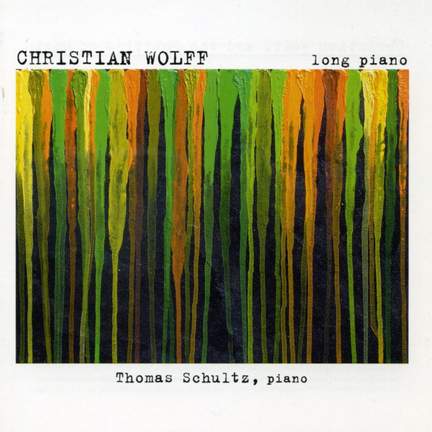
Wolff, C: Long Piano (Peace March 11)
Thomas Schultz (long piano)
Purchase product

About
The melodic and, in the case of the solo piano music, timbral materials from which Christian Wolff's (b. 1934) music is made are rarely unusual; these are ordinary, everyday things. However, Wolff's rhythmic invention is of great range and variety: complex polyrhythms, speech-like-rhythms, the music flowing at a freely fluctuating rate or proceeding in a plain, straightforward manner, silences. This mix of unusual and ordinary results in a music unlike any other. And, in a piece of such length as Long Piano, the ongoing appearance and accumulation of a great number and variety of short passages results in the constant renewing and refreshing of the listener's perception. This is the world-premiere recording of the composer's largest solo keyboard work to date.
"[Long Piano] seems to me like a kind of geological agglomeration. My hope is that it forms a possible landscape on one extended canvas. At first I just started writing and kept going. My tendency is to work in smaller patches. After the piece was finished I saw Jennifer Bartlett's wonderfully engaging and cheerful work Rhapsody, first shown in 1976. It's a 154-foot sequence of an arrangement of 988 one-foot-square silk-screened and painted enamel plates running around at least three walls of a gallery space. An extreme instance of what I've got in mind.
I had decided not to use the commonest procedure for long keyboard pieces, variations (e.g., Frescobaldi, Bach, Beethoven, Rzewski), but sometimes there are series of patches that use tunes (for instance, the very old standby "L'homme armé" and the round "Dona nobis pacem") for material. The piece has 94 numbered patches, a few of which are blank (silence) (in Bartlett's piece there are the occasional blank squares). The 57th to 67th patches refer to eleven larger sections of a square-root rhythmic structure, each of which has eleven subdivisions whose time proportions are the same as those of the larger sections. The piece also incorporates partial versions (more or less "parodies" in the old music sense) of Schumann (the Toccata and one of the Kinderszenen) and Ives's Three-Page Sonata.
Contents and tracklist
- Thomas Schultz