Lutosławski: Orchestral Works 1
BBC Symphony Orchestra, Edward Gardner
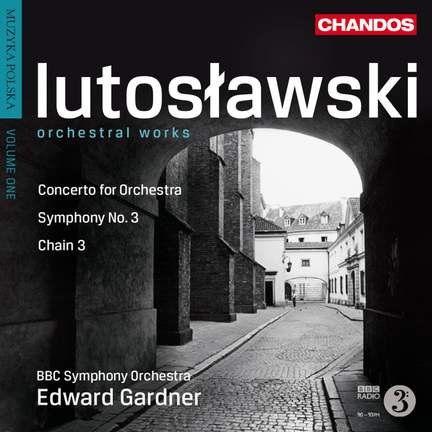
Awards:
-
Sunday Times, 2010, Albums of the Year

-
Gramophone Magazine, December 2010, Editor's Choice

Gardner makes the most of the taut rhythmic energy in the music...all the colours of this showpiece [the Concerto for Orchestra] are brightly painted, with a virtuosity which is never empty,...
Lutosławski: Orchestral Works 1
BBC Symphony Orchestra, Edward Gardner
Purchase product

Awards:
-
Sunday Times, 2010, Albums of the Year
-
Gramophone Magazine, December 2010, Editor's Choice
Gardner makes the most of the taut rhythmic energy in the music...all the colours of this showpiece [the Concerto for Orchestra] are brightly painted, with a virtuosity which is never empty,...
About
Edward Gardner, the music director of English National Opera and an exclusive Chandos artist, has completed the first disc in a projected Chandos series devoted to Polish music. Also his first purely orchestral CD for Chandos, the disc presents music by one of Poland’s most important twentieth-century composers, Witold Lutosławski, including perhaps his most famous work, the Concerto for Orchestra (1950 – 54), a brilliant and highly attractive work.
Also included is the Third Symphony (1981 – 83) which was given its world premiere by the Chicago Symphony Orchestra, conducted by Sir Georg Solti, on 29 September 1983. Many passages employ the by then well-developed technique which the composer called ‘limited aleatorism’, according to which each individual orchestral musician is asked to play a phrase or repeated fragment in his own time – rhythmically independent of the other musicians. During these passages very little synchronisation is specified: events that are coordinated include the simultaneous entrances of groups of instruments, the abrupt end of some episodes, and some transitions to new sections. By this method the composer retains control of the work’s architecture and of the realisation of the performance, while simultaneously facilitating complex and unpredictable polyphony.
In later years Lutosławski developed musical forms that combine unrelated strands of music, whose short, discrete sections overlap one another like the links of a chain. Elements of this method can be found in many of his earlier works, but the first to emphasise it was Chain 1 of 1983 for fourteen instruments, written for the London Sinfonietta. Chain 2, subtitled ‘Dialogue for Violin and Orchestra’, followed in 1985.
The last work to adopt this approach was Chain 3 (1986) for large orchestra. Broadly speaking, the composition’s ten-minute span falls into three sections, of which the first provides a particularly clear, readily audible example of the chain technique. After a quick opening flourish, Lutosławski presents a sequence of twelve overlapping ideas, each characterised by a particular mode of expression, and each vividly coloured by a few instruments playing as a unit. For example, chimes, violas, and flutes together form the first ‘link’; this is overlapped by a quartet of double-basses; these in turn overlap a xylophone and three violins, and so on. The last of the twelve links in this musical chain thicken into a kind of general babble among the winds, which marks the first stage in the work’s larger form. Chain 3 was written for the San Francisco Symphony which gave the first performance, conducted by the composer, on 10 December 1986 in Davies Symphony Hall in San Francisco.
Contents and tracklist
Awards and reviews
-
Sunday Times2010Albums of the Year
-
Gramophone MagazineDecember 2010Editor's Choice
 December 2010
Gardner makes the most of the taut rhythmic energy in the music...all the colours of this showpiece [the Concerto for Orchestra] are brightly painted, with a virtuosity which is never empty, but always has direction and purpose, and a sense of real enjoyment.
 2nd November 2010
Gardner’s ENO-honed ability to choose and hold a tempo and set a tangible mood from the off serves him well in each movement: there’s tautness and weight in the Intrada’s production line of pounding rhythms, a fine sense of pace to the slow-burn Passacaglia and impressive lightness in the piquant woodwind flutterings
 16th October 2010
This CD offers a thrilling reminder of [Lutoslawski's] craftsmanship...Chain 3 is a small, brilliant orchestral jewel. Atmospheric, if not quite virtuosic, performances from the BBC Symphony Orchestra under Gardner, who must be encouraged to explore more of Lutoslawski’s oeuvre.
 December 2010
On this evidence, Edward Gardner and the BBC SO are a dream team, pressing the claims of a composer who has been neglected since his death in 1994...This performance sets a seal on a disc that leaves one eager for its successors
 December 2010
Gardner pulls no punches in the 'Intrada'...few have equalled this for long-term conviction, in which the playing of the BBC forces leaves little to be desired...Gardner's interpretations are much more 'inside' the idiom than Daniel Barenboim's rather dutiful readings...this disc can be warmly recommended, not least if it hastens the return of Lutoslawski's music to its former eminence.
 24th October 2010
Exciting performances of exciting music. Lutoslawski is a master of whipping up the orchestra, though in a tasteful, increasingly refined manner...A fanfare guides us through the novel form [of the Symphony], though Gardner is a persuasive guide in his own right.
 14th October 2010
Their account of the concerto is lively and crisply virtuosic, but the performances of the other two, much later works on this disc are the more significant...Gardner's performance [of Symphony No. 3] is impressive – vivid, incisive and well controlled – and he does an equally good job on the slighter and more elusive Chain 3 from 1986.