Schubert - Schwanengesang & Lieder
Dietrich Henschel (baritone) & Fritz Schwinghammer (piano)
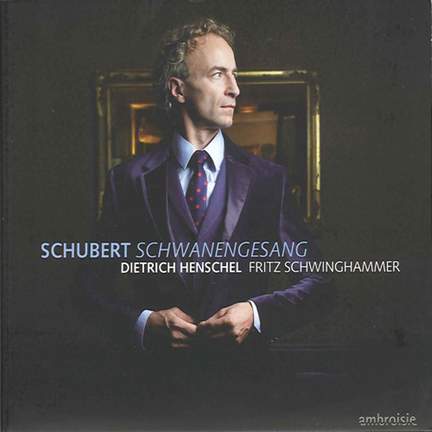
In this studio account of Schubert's final song collection...there is still an enormous amount to admire - in the way that Henschel colours every line individually and, unlike some celebrated...
Schubert - Schwanengesang & Lieder
Dietrich Henschel (baritone) & Fritz Schwinghammer (piano)
Purchase product

In this studio account of Schubert's final song collection...there is still an enormous amount to admire - in the way that Henschel colours every line individually and, unlike some celebrated...
About
Dietrich Henschel, acknowledged as one of today’s foremost interpreters of the lied, records a stunning programme of Schubert lieder, including his posthumously issued collection of lieder known as ‘Schwanengesang’, accompanied by award-winning pianist, Fritz Schwinghammer. The recital touches on the very essence of the Romantic soul, somewhere between bitter dreams and heartrending sorrows.
Schwanengesang, a collection of 14 songs published shortly after his death, are considered some of Schubert’s most tragic songs, offering the listener an arresting concentration of the composer’s imaginative universe and his obsessions: departure, the death of the beloved, amorous reveries. The set of songs accompanying this great cycle, sees Schubert explore one of the prevailing features of early German Romanticism: a longing for a better world, one that is lost forever. In doing so, he draws on the mythological poems of Goethe, Schiller and Mayrhofer.
German baritone Dietrich Henschel is acknowledged as one of today’s foremost interpreters of the lied, and is invited all over the world with the pianists Fritz Schwinghammer, Helmut Deutsch and Michael Schäfer. His substantial discography features lieder and song cycles by Mahler, Wolf, Schubert, Korngold, and Beethoven, as well as Busoni’s Doktor Faust which won a Grammy Award.
Contents and tracklist
- Dietrich Henschel (baritone), Fritz Schwinghammer (piano)
- Dietrich Henschel (baritone), Fritz Schwinghammer (piano)
- Fritz Schwinghammer (piano), Dietrich Henschel (baritone)
- Dietrich Henschel (baritone), Fritz Schwinghammer (piano)
- Fritz Schwinghammer (piano), Dietrich Henschel (baritone)
- Fritz Schwinghammer (piano), Dietrich Henschel (baritone)
Awards and reviews
 31st July 2009
In this studio account of Schubert's final song collection...there is still an enormous amount to admire - in the way that Henschel colours every line individually and, unlike some celebrated lieder baritones of today, never applies a uniform expressivity to everything he sings, and in the fine-grained expressive nuances with which he weights the meaning and significance of every word.
 26th July 2009
[Henschel's] voice is as flexible as ever, rich and commanding one moment and drained of all colour the next. Henschel and Schwinghammer convince us that this is no mere random selection of songs gathered after Schubert's death, as some believe, but a dramatic narrative that demands our attention.
 11th August 2009
Dietrich Henschel studied with Dietrich Fischer-Dieskau and the latter’s stamp is clearly imprinted on his singing of Schubert’s last song-cycle. Henschel is never less than elegant, virile and intelligent.
 1st August 2009
You couldn’t call Henschel’s bass-baritone voice suave, but his reedy tone can be very expressive when applied to songs of anguish. There are plenty of those in Schubert’s posthumous lieder collection.