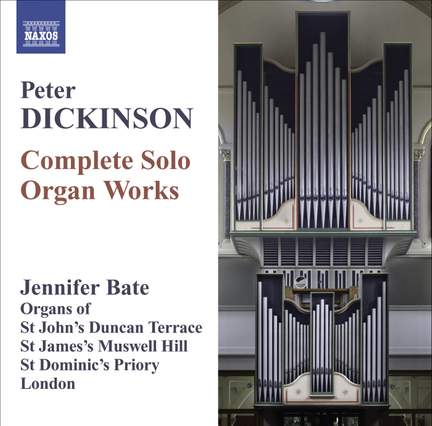
Peter Dickinson - Complete Solo Organ Works
Jennifer Bate (Organs of St John’s Duncan Terrace, St James’s Muswell Hill & St Dominic’s Priory)
The student pieces that begin this fascinating disc demonstrate the expected ability to identify with the musical worlds of Vaughan Williams and Herbert Howells, though one piece at least –...
Peter Dickinson - Complete Solo Organ Works
Jennifer Bate (Organs of St John’s Duncan Terrace, St James’s Muswell Hill & St Dominic’s Priory)
Purchase product

The student pieces that begin this fascinating disc demonstrate the expected ability to identify with the musical worlds of Vaughan Williams and Herbert Howells, though one piece at least –...
About
Peter Dickinson’s strikingly original approach to organ music, which the composer himself has described as ‘far from the English cathedral tradition’, reflects a background that was not typical of British organists or composers during the mid- to late-twentieth century.
The award-winning, internationally-renowned organist Jennifer Bate is an ideal interpreter of his works, which range from the introspective A Cambridge Postlude to the improvisatory Three Statements and the awe-inspiring Millennium Fanfare.
This disc includes several world première recordings.
A recent recording of Peter Dickinson’s work was described in the following glowing terms by Fanfare: “A top notch CD, and by the end of the year possibly a Want List recommendation.”
“Jennifer Bate [is] a remarkable organist… Needless to say Jennifer Bate's performances are superb….Well worth investigating.” MusicWeb International on a previous recording
Contents and tracklist
Awards and reviews
 2010
2010
The student pieces that begin this fascinating disc demonstrate the expected ability to identify with the musical worlds of Vaughan Williams and Herbert Howells, though one piece at least – the Postlude on Adeste fideles – shows signs of a more abrasive idiom, as if Ives were waiting in the wings. The Meditation on Murder in theCathedral is another, quite different kind of early acknowledgement that the dissonance and a sense of disquiet so common in contemporary concert music by 1958 could be no less relevant to the organ loft.
When Dickinson exchanged Cambridge for New York in the late 1950s, that potential for responding to changes taking place in the wider musical world began to be realised with interest.
The organ works from the 1960s which followed his return to the UK reveal the edgy, angular perspectives stemming from Dickinson's familiarity with composers as different as Copland and Cage. However, neither Three Statements nor Paraphrase 1 are pale imitations of such composers – nor, for that matter, of other Dickinson enthusiasms such as Satie and Berners. Only with the exuberant, ebullient absorption of blues and rag music found in Blue Rose Variations (1985) do specific stylistic associations emerge, and this piece remains an invigorating blast of fresh air, a kind of secular equivalent to Messiaen's ecstatic spiritual dances.
The Dickinson journey is traced here in supremely well articulated and strongly characterised performances by Jennifer Bate. The three organs involved are recorded with maximum fidelity and no sense of distortion, even in the loudest passages. The disc is a fine birthday tribute to a composer who has escaped the confines of the predictable without ever ceasing to communicate.
 July 2009
The Dickinson journey is traced here in supremely well articulated and strongly characterised performances by Jennifer Bate. The disc is a fine birthday tribute to a composer who has escaped the confines of the predictable without ever ceasing to communicate.