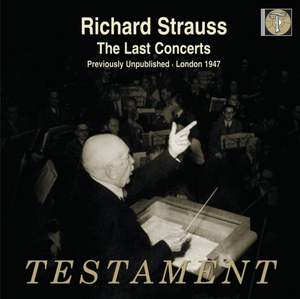
Strauss - The Last Concerts
Alfred Blumen (piano)
Philharmonia Orchestra, BBC Symphony Orchestra, Richard Strauss
'One of my chief pleasures is to hear Till and DonJuan on the wireless, conducted by yourself.
What a difference!' So wrote the 91-year-old George Bernard Shaw to the 83-year-old Richard Strauss...
Strauss - The Last Concerts
Alfred Blumen (piano)
Philharmonia Orchestra, BBC Symphony Orchestra, Richard Strauss
Purchase product
'One of my chief pleasures is to hear Till and DonJuan on the wireless, conducted by yourself.
What a difference!' So wrote the 91-year-old George Bernard Shaw to the 83-year-old Richard Strauss...
About
The festival of Richard Strauss’s music held in London during October 1947 was the result of a joint initiative by Sir Thomas Beecham and Ernst Roth, Richard Strauss’s publisher at Boosey & Hawkes. A vital part of this initiative was the presence of the composer himself. Strauss and his wife were then living as impoverished exiles in Switzerland: UK performance royalties on the composer’s work had been frozen during the war, but if he came to England he could collect those royalties and gather new payments for performances of his music – and he could also earn a good fee if he conducted. The festival opened with two concerts at the Theatre Royal, Drury Lane, given by the Royal Philharmonic Orchestra under Beecham, in the presence of an approving Strauss. Beecham also conducted two concert performances of the opera Elektra at the BBC’s Maida Vale studios, again with a very satisfied composer in attendance. Important events these may have been, but the highlight of the festival was a concert at the Royal Albert Hall on the Sunday evening of 19 October, in which Strauss himself conducted the Philharmonia Orchestra in a programme of three works, Don Juan, the Burleske for piano and orchestra and the Sinfonia domestica, with a new symphonic arrangement of the waltzes from Der Rosenkavalier as an encore. It is said that Strauss wanted to conduct his Alpine Symphony, and that the huge instrumental forces required in this work made it economically impossible, but he would have been content with the choice of the Sinfonia domestica, since its homespun subject matter made it a favourite among his own works. This too needed a large orchestra, and well-known extra players from other London orchestras were recruited for the occasion, including the Royal Philharmonic’s clarinettist, Jack Brymer. For the Burleske Strauss chose the little-known pianist Alfred Blumen as soloist. Blumen had worked with Strauss on several occasions over a period of many years, notably in a long tour of South America with the Vienna Philharmonic Orchestra in 1923, during which they gave performances of Beethoven’s Emperor Concerto in addition to the Burleske. Now living in Britain, Blumen had also fallen on hard times, and Strauss wanted his old colleague to earn a concert fee.
Extract from the note Alan Sanders, 2008
Contents and tracklist
- Alfred Blumen (piano)
- Philharmonia Orchestra
- Richard Strauss
Awards and reviews
2010
'One of my chief pleasures is to hear Till and DonJuan on the wireless, conducted by yourself.
What a difference!' So wrote the 91-year-old George Bernard Shaw to the 83-year-old Richard Strauss shortly before Christmas 1947. Shaw was referring to the two concerts broadcast from the Royal Albert Hall that autumn by the BBC Third Programme during the festival of Strauss's music which the BBC, Sir Thomas Beecham and Strauss's London publishers had jointly sponsored.
In Till and briefly in Domestica there is audible interference from an adjacent station. Leech also lacked a second machine, which means that, the Burleske apart, brief sections of music are missing every four or five minutes. Not that this matters. Such is the fascination of the musicmaking, the hiatuses are, in Lady Bracknell's word, 'immaterial'.
The transfers of Leech's flawed acetates are by Testament's miracle-worker-in-chief Paul Baily.
Examples of what the acetates sounded like before treatment are cheekily offered as an addendum to disc 2. The transformation is astonishing. Perhaps Baily should have a go at Strauss's 1929 Berlin Staatskapelle recording of Don Juan. Until he does, we are bound to conclude that this live Philharmonia performance is not only fierier and more expressive but far better played.
Strauss had a famously economical beat. Even so, for a man of 83 to conduct a concert of this length at this pitch of intensity – after the three principal works he threw in the Rosenkavalier waltzes for good measure – is astonishing. In the opening of Don Juan he yields to no one, not even Toscanini, in the brilliance of his attack, yet in the lyric sections there is a yearning loveliness that put me in mind of the fact that in October 1947 the Four Last Songs were already gestating.
What a crossing of the years is here! What is true of Don Juan is doubly true of this startlingly wonderful performance of Symphoniadomestica, a work Strauss loved more than some of his public did. This London account communicates fervently his tender and passionate belief in the piece.
The Till Eulenspiegel, which he conducted 10 days later during one of Sir Adrian Boult's BBC SO concerts, is less remarkable, too slow and careful. Why, one asks, was the fledgling Philharmonia the more empathetic ensemble, conjuring forth phrasing and nuances the Vienna Philharmonic would have been proud to own? Beecham may be the answer. Many of the Philharmonia's players had worked for the old wizard whose mastery of Strauss's music went back four decades.
The hiring of the gifted and witty but barely remembered Austrian-born Jewish pianist Alfred Blumen was both personal and political.
An acquaintance of Strauss, Blumen had spent the war in an internment camp in the north of England. There were reports of disagreements in rehearsal, Strauss telling Blumen to slow down, Blumen muttering how Strauss used to speed through Burleske. Neither man hangs about.
April 2009
…for a man of 83 to conduct a concert of this length at this pitch of intensity… is astonishing. In the opening of Don Juan he yields to no one, not even Toscanini, in the brilliance of his attack, yet in the lyric sections there is a yearning loveliness... What is true of Don Juan is doubly true of this startlingly wonderful performance of Symphonia domestica... this London account communicates... fervently his tender and passionate belief in the piece.