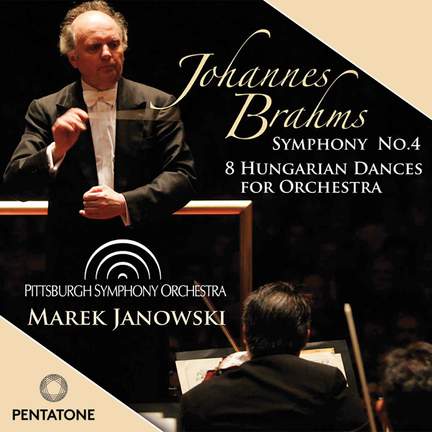
Brahms - Symphony No. 4 & Hungarian Dances
Pittsburgh Symphony Orchestra, Marek Janowski
Awards:
-
Gramophone Magazine, March 2009, Editor's Choice

It's been true for many years now that American orchestras have been sounding more middle- European, but the Pittsburgh Symphony could easily be mistaken for a top German orchestra, like Leipzig...
Brahms - Symphony No. 4 & Hungarian Dances
Pittsburgh Symphony Orchestra, Marek Janowski
Purchase product
Awards:
-
Gramophone Magazine, March 2009, Editor's Choice
It's been true for many years now that American orchestras have been sounding more middle- European, but the Pittsburgh Symphony could easily be mistaken for a top German orchestra, like Leipzig...
About
This release marks the completion of the Brahms symphony cycle with The Pittsburg Symphony Orchestra conducted by Marek Janowski. This series has been warmly applauded. “Classics Today” awarded previous releases in this cycle ‘10 out of 10’ and Classic FM Magazinze awarded the recordings of symphonies 2 & 3 “Disc of the Month”.
Contents and tracklist
- Pittsburgh Symphony Orchestra, Marek Janowski, Pittsburg Symphony Orchestra
Brahms:
21 Hungarian Dances, WoO 1 (Version for Orchestra): No. 1 in G Minor. Allegro molto
Work length3:04
- Marek Janowski, Pittsburg Symphony Orchestra
Brahms:
21 Hungarian Dances, WoO 1 (Version for Orchestra): No. 3 in F Major. Allegretto
Work length2:16
Brahms:
21 Hungarian Dances, WoO 1 (Version for Orchestra): No. 10 in F Major. Presto
Work length1:44
Brahms:
21 Hungarian Dances, WoO 1 (Version for Orchestra): No. 17 in F-Sharp Minor. Andantino
Work length2:45
Brahms:
21 Hungarian Dances, WoO 1 (Version for Orchestra): No. 18 in D Major. Molto vivace
Work length1:24
Brahms:
21 Hungarian Dances, WoO 1 (Version for Orchestra): No. 19 in B Minor. Allegretto
Work length1:48
Brahms:
21 Hungarian Dances, WoO 1 (Version for Orchestra): No. 20 in E Minor. Poco Allegretto
Work length2:09
Brahms:
21 Hungarian Dances, WoO 1 (Version for Orchestra): No. 21 in E Minor. Vivace
Work length1:37
Awards and reviews
-
Gramophone MagazineMarch 2009Editor's Choice
 2010
2010
It's been true for many years now that American orchestras have been sounding more middle- European, but the Pittsburgh Symphony could easily be mistaken for a top German orchestra, like Leipzig or Dresden, in this music. Listen to the slow movement of the Fourth Symphony where Marek Janowski really has his players leaning into the harmonic radiance of the writing. All those wondrous transfigurations evolve so naturally and so dreamily that the brawny exuberance of the Scherzo – tough and resilient in Janowski's hands – really does come as an unexpected blast.
Approaches differ greatly with regard to the highly innovative first movement, the whole of which constitutes a development of sorts. So, how soon do the darkening clouds descend? For some they cannot descend soon enough. But here it's as if Janowski is delaying the inevitable right through to the high anxiety of the final pages. He tightens the screw relatively late in the movement. The slow movement then restores some sense of prior well-being and inner calm, as does the still centre of the finale with its tranquil flute and trombone-led chorale variation. The refulgence of the playing is a constant source of pleasure.
The Hungarian Dances come in Brahms and Dvorák's orchestrations, their kinship self-evident.
They are earthy and sinewy with plenty of surge factor in the lower strings and the requisite cheekiness in the phrasing exemplified by those traditionally tantalising hesitations and stomping downbeats.
 March 2009
…the Pittsburgh Symphony - increasingly one of the nation's finest - could easily be mistaken for a top German orchestra, like Leipzig or Dresden, in this music. The refulgence of the playing is a constant source of pleasure and any conductor who is as mindful of Brahm's ingenuity, invention and sheer vision as Janowski demands to be heard. The Hungarian Dances... are earthy and sinewy with plenty of surge factor in the lower strings and the requisite cheekiness in the phrasing exemplified by those traditionally tantalising hesitations and stompling downbeats.