

Hindemith: Das Unaufhörliche
Ulrike Sonntag, Robert Wörle, Siegfried Lorenz, Artur Korn
Berlin Radio Children's Choir, Berlin Radio Chorus, Lothar Zagrosek
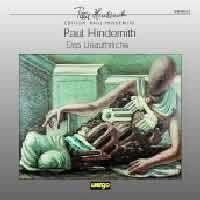
The oratorio Das Unaufhörliche ('The One Perpetual') was Hindemith's longest concert work.
It never established itself in the repertoire (although Boult conducted the UK premiere as early as...
Hindemith: Das Unaufhörliche
Ulrike Sonntag, Robert Wörle, Siegfried Lorenz, Artur Korn
Berlin Radio Children's Choir, Berlin Radio Chorus, Lothar Zagrosek
Purchase product
The oratorio Das Unaufhörliche ('The One Perpetual') was Hindemith's longest concert work.
It never established itself in the repertoire (although Boult conducted the UK premiere as early as...
About
Paul Hindemith was motivated to work with Gottfried Benn after he had read his article "Can Writers Change the World?". In it Benn states, in opposition to the political program of salvation of his days: History has no overarching sense, no upward movement, no dawning of humanity, a motif of the Orient, a myth of the Mediterranean Sea; it survives the Niagara Falls, only to drown in the bathtub; necessity calls and randomness answers. Benn then gave form to these views in his poem "Das Unaufhörliche", which is supposed to express the self-transformation of the creative act.
Hindemith was confronted with the paradoxical problem that he could in no way express the principle of the perpetual, to which as an art form music, too, is subject, by means of an emphatically autonomous music. Instead, he sought to embody the principle of the perpetual in his basic compositional decisions. Hindemith succeeds by always giving something fictive to the "organic" closed forms of the "natural" musical flow. The principle of the perpetual is assigned to three themes, which almost all of the work’s other themes are derived from in the most subtle, unobtrusive art of transformation. And when the final chorus returns to these three themes in their original form, it makes thematically manifest what was always latently present: the principle of the perpetual.
The CDs also contain an original recording of Gottfried Benn reading an introduction to the oratorio in 1932. The booklet presents - besides the liner notes of Giselher Schubert in German, English and French - the libretto in German and English (libretto translated by the British composer Cyril Scott).
Contents and tracklist
- Ulrike Sonntag, Robert Wörle, Siegfried Lorenz, Artur Korn
- Berlin Radio Children's Choir, Berlin Radio Chorus
- Lothar Zagrosek
Awards and reviews
 2010
The oratorio Das Unaufhörliche ('The One Perpetual') was Hindemith's longest concert work.
It never established itself in the repertoire (although Boult conducted the UK premiere as early as 1933). It's cast in three parts, the first describing the 'one perpetual' itself, the second its effect on diverse areas of activity (including art, science and love), the third Humankind's reaction away from it and final acquiescence.
How closely Hindemith accorded with the poet Gottfried Benn's viewpoint is a matter for con- jecture, but his evanescent score matched the poem's expansiveness of theme and nobility of utterance. In this alone it pointed the way to Mathis der Maler, for there's nothing here akin to the Kammermusiken or Neues vom Tage (a smash-hit in Berlin at the time).
This is the work's first recording and the performance is a fine one with good sound. Flies in the ointment? Soprano Ulrike Sonntag, who seems too often to be straining for her notes and whose intonation isn't always secure, and Wergo's failure to provide a translation of Benn's spoken introduction, recorded in 1932 and included as the final track. These are quibbles, however, and should not deter anyone from investing in this important release.
