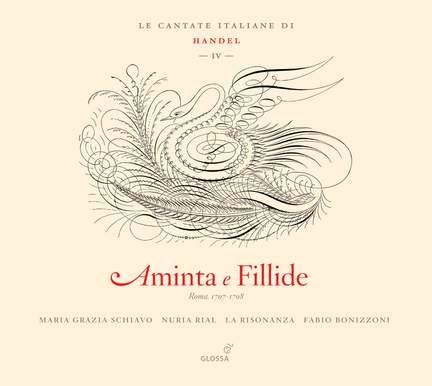
Handel - Italian Cantatas Volume 4
Aminta e Fillide, Rome (1707-1708)
Maria Grazia Schiavo (Aminta), Nuria Rial (Fillide), Maria Grazia Schiavo (soprano)
La Risonanza, Fabio Bonizzoni (harpsichord/director)
Awards:
-
Gramophone Magazine, December 2008, Editor's Choice

The fourth instalment of La Risonanza's survey of Handel's youthful Italian cantatas is devoted to two works probably composed for the Marquis Francesco Maria Ruspoli in Rome. There is no doubt...
Handel - Italian Cantatas Volume 4
Aminta e Fillide, Rome (1707-1708)
Maria Grazia Schiavo (Aminta), Nuria Rial (Fillide), Maria Grazia Schiavo (soprano)
La Risonanza, Fabio Bonizzoni (harpsichord/director)
Purchase product

Awards:
-
Gramophone Magazine, December 2008, Editor's Choice
The fourth instalment of La Risonanza's survey of Handel's youthful Italian cantatas is devoted to two works probably composed for the Marquis Francesco Maria Ruspoli in Rome. There is no doubt...
About
Recorded in Saint Michel en Thiérache, France, in June 2007.
Two new voices join Fabio Bonizzoni's project of recording the entirety of the cantatas with instrumental accompaniment which Handel composed when in Italy: sopranos Nuria Rial and Maria Grazia Schiavo enter the company of Roberta Invernizzi, Emanuela Galli, Raffaella Milanesi and Salvo Vitale, the singers who we have been able to hear in the first three volumes of the collection. In this fourth instalment (out of a total of seven CDs planned for release up to the end of 2009), we rediscover the patronage of the Marquis Francesco Maria Ruspoli, which lay behind the important cantata a due entitled Aminta e Fillide; this was a work which was to provide the composer with a veritable seam of musical material for use, as 'borrowings', in his operas Agrippina and Rinaldo - one of the reasons perhaps why this cantata has been rarely performed and even less recorded. Both Aminta e Fillide and the extensive cantata for soprano, Clori, mia bella Clori, which rounds off this new disc, had their origins in the special environment of the Accademia degli Arcadi, that literary society founded by a group of aristocrats, cardinals, poets, thinkers and composers in 1690, which used to hold its meetings in idyllic spots around Rome. Karl Böhmer's informed notes contained in the CD booklet suggest a number of stimulating points of view about the meaning and significance of these works for the Arcadians.
Contents and tracklist
- Maria Grazia Schiavo (soprano)
- Risonanza, La
- Fabio Bonizzoni
Awards and reviews
-
Gramophone MagazineDecember 2008Editor's Choice
 2010
2010
The fourth instalment of La Risonanza's survey of Handel's youthful Italian cantatas is devoted to two works probably composed for the Marquis Francesco Maria Ruspoli in Rome. There is no doubt that Arresta il passo (nicknamed 'Aminta e Fillide') is one of the young Handel's most likeable compositions. The Arcadian story of Aminta imploring Fillide to requite his love, and of her gradual melting towards his seduction, is told by La Risonanza in an affectionate and conversational way, with recitatives unhurried and performed with clarity, precision and elegance. Bonizzoni resists the temptation to ham things up too much, and directs the music with a judicious ear for striking yet tasteful sonority.
Sopranos Maria Grazia Schiavo (Aminta) and Nuria Rial (Fillide) achieve the elusive synthesis between stylised poetry, musical refinement and dramatic character. The radiant violin-playing in Fillide's 'Fu scherzo, fu gioco' is a delicately playful illustration of the text's reference to love being a joke and a game, and Rial sings the difficult vocal part effortlessly and with delicious sagacity. Schiavo is equally impressive in Aminta's 'Se vago rio', which has a spellbinding pizzicato string accompaniment and strange harmonic twists. Fillide's surprise at her emerging feelings of love for Aminta, and his increasing elation, are delightfully conveyed by all of the vocal and instrumental performers.
Clori, mia bella Clori (sung by Schiavo) also benefits from meticulous attention to detail, such as the exquisitely shaded duetting violins in 'Mie pupille'. La Risonanza once again show that Handel's youthful Italian compositions are breathtaking masterpieces of considerable refinement, subtlety and quality.