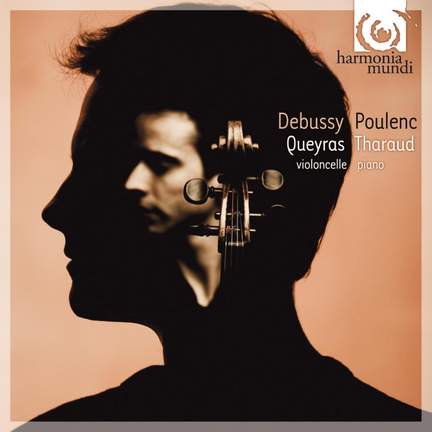
Special offer. Debussy & Poulenc - Cello Sonatas
Jean-Guihen Queyras (cello) & Alexandre Tharaud (piano)
Awards:
-
Diapason d’Or de l’Année, 2008

Vividly captured in a warm acoustic, Queyras and Tharaud's is an intimate approach which exactly suits the two short sonatas of Debussy and Poulenc, the former with its abrupt changes of direction...
Special offer. Debussy & Poulenc - Cello Sonatas
Jean-Guihen Queyras (cello) & Alexandre Tharaud (piano)
Purchase product

Awards:
-
Diapason d’Or de l’Année, 2008
Vividly captured in a warm acoustic, Queyras and Tharaud's is an intimate approach which exactly suits the two short sonatas of Debussy and Poulenc, the former with its abrupt changes of direction...
About
Debussy and Poulenc made a lasting impact on the musical identity of their country through both their references to the past and their innovations.This programme illustrates their vision of a certain esprit français: moving constantly between irony and emotion, extremely refined, yet at the same time offering an amplified echo of 'light' music - in short, the 'exquisite bad music' the creator of Les Mamelles de Tirésias prided himself on writing. Jean-Guihen Queyras and Alexandre Tharaud, upcoming interpreters of the young generation in France, have already made several recordings together and frequently programme these works in concert.Their recording of Schubert's Arpeggione Sonata was a Gramophone Editor's Choice.
"I got to know the Poulenc sonata, thanks to Alexandre, who I believe (although I haven't yet managed to make him admit it) must have learnt to play this music before he started walking; it just seems to flow from his fingers as if it were second nature." J-G Queyras
Long a soloist with the Ensemble Intercontemporain, Jean-Guihen Queyras was profoundly influenced by working with Pierre Boulez. His discography, distinguished by a musical eclecticism, includes works by Haydn (on period instruments) as well as Dvorák and 20th-century composers. He has premiered concertos by Ivan Fedele, Gilbert Amy, Bruno Mantovani and Philippe Schoeller (Wind's Eyes), some of which will be recorded for harmonia mundi in late 2008. Alexandre Tharaud devotes a large part of his activity to chamber music. His recording of Schubert's Arpeggione Sonata with Jean-Guihen received unanimous critical acclaim. An enthusiastic advocate of contemporary music, he premiered Thierry Pécou's cycle Outre-Mémoire, as well as his concerto L'Oiseau innumérable (HMC901974, July 2008). His recital programmes 'Hommages' intersperse harpsichord pieces by Rameau and Couperin played on the piano with tributes by living composers.
Contents and tracklist
Awards and reviews
-
Diapason d’Or de l’Année2008
 2010
2010
Vividly captured in a warm acoustic, Queyras and Tharaud's is an intimate approach which exactly suits the two short sonatas of Debussy and Poulenc, the former with its abrupt changes of direction and unpredictable mood swings, the latter brimful of Poulencian wit and, not surprisingly as it was sketched in 1940 (completed in 1948), replete with some self-plagiarising from Babar.
These are fine accounts, the programme made even more attractive by the inclusion of the seven short movements of Poulenc's Suite française (1935) based on 16th-century dances by Claude Gervaise. It's a charmer. Apart from this, there are five other short works by the two composers making a truly delightful whole.