Wellesz: String Quartets
Artis-Quartett Wien
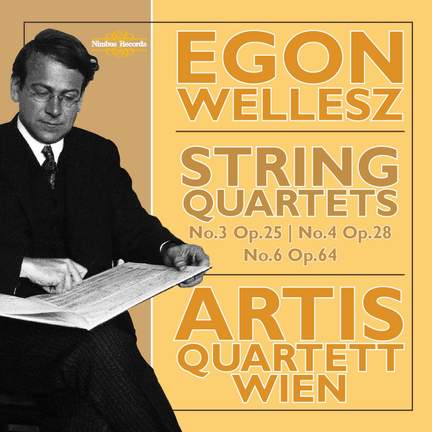
Viennese composer Egon Wellesz was very much a product of his times. Mahler's conducting was an early influence, while Schoenberg and von Hofmannsthal were influential associates.
Once Hitler's...
Wellesz: String Quartets
Artis-Quartett Wien
Purchase product

Viennese composer Egon Wellesz was very much a product of his times. Mahler's conducting was an early influence, while Schoenberg and von Hofmannsthal were influential associates.
Once Hitler's...
About
Egon Wellesz (1885–1974) was an Austrian composer, teacher and musicologist, a pupil of Arnold Schoenberg and an eminent scholar of Byzantine music. Wellesz left Austria for England in the wake of the Anschluss and spent the remainder of his life at Oxford University, where he taught from 1932. He wrote nine symphonies and nine string quartets, the latter series of works spread throughout his life. His earliest music is in a harsh but tonal style. There is a definite second period in which his music has a somewhat Brucknerian sound and towards the end of his life the music becomes more pan-tonal and serial in character. Wellesz’ works as a composer amount to at least 130 works in a variety of mediums; composing for the stage as well as for the concert hall. Recently, interest in Wellesz' music has increased, in particular his nine symphonies have been recorded to great acclaim. The Quartets performed on this CD are premiere recordings.
Contents and tracklist
Awards and reviews
 2010
2010
Viennese composer Egon Wellesz was very much a product of his times. Mahler's conducting was an early influence, while Schoenberg and von Hofmannsthal were influential associates.
Once Hitler's hordes had conquered Europe he landed in Oxford where he became a Reader in Byzantine music. For a while the trauma of exile blocked Wellesz's creative impulse but he recovered well, and by the time of his death in 1972 had clocked up an impressively varied output. The quartets cover the length and breadth of Wellesz's career, the earliest here, the Third (1918), reflecting key Romantic and 'Impressionist' influences, the turbulent second movement starting out in the manner of Chausson, the rest more indebted perhaps to Debussy and early Schoenberg.
There's also, in the fugal passages of the finale, a hint of Max Reger's playful counterpoint.
The curve of Wellesz's development reflects a trend similar to many of his contemporaries: early romanticism gives way, in the 1920s and beyond, to confrontational modernism eventually leading to a cooler, post-classical style. The Fourth Quartet (1922) is terse, aphoristic and tautly argued, each of its five movements shorter in length than you might expect, its style intense and inscrutable. Calum MacDonald's invaluable note suggests an audible prophecy of Berg's Lyric Suite and there some telling similarities to Bartók too.
The Sixth Quartet (1947) opens like a homage to Beethoven's Coriolan Overture and the classical axis remains in place more or less throughout, especially in the middle movements. Performance- wise one could hardly ask for more in the way of dedication or perception.