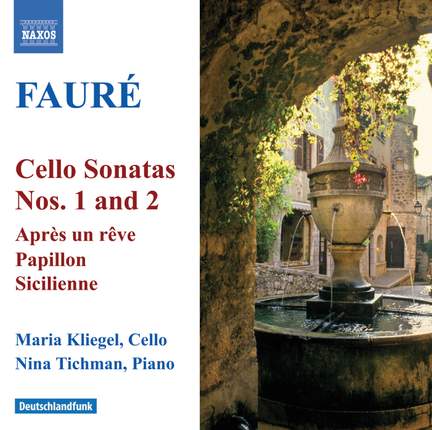
Fauré - Cello Sonatas Nos. 1 & 2
Maria Kliegel (cello) & Nina Tichman (piano)
Nina Tichman uses Fauré's powerful left-hand lines correctly as counterweight to the cello's soaring tunes. Impassioned playing from her Kliegel gives us not only the two sonatas, but also...
Fauré - Cello Sonatas Nos. 1 & 2
Maria Kliegel (cello) & Nina Tichman (piano)
Purchase product

Nina Tichman uses Fauré's powerful left-hand lines correctly as counterweight to the cello's soaring tunes. Impassioned playing from her Kliegel gives us not only the two sonatas, but also...
About
Fauré’s two cello sonatas are compact, beautifully written works whose musical language, with its many subtle changes of tonality and gift for melody, has been described as conveying ‘the power of tranquil thought’. Written in the summer of 1917, during the First World War, the neglected First Sonata begins with a troubled Allegro, followed by an eloquent Andante and a sparkling Finale. The C minor Andante of the Second Sonata has its origin in a Chant funèbre commissioned for the celebration in May 1921 of the centenary of the death of Napoleon. This recital also includes an arrangement of the ever-popular song Après un rêve, as well as the virtuosic Papillon.
Contents and tracklist
- Maria Kliegel (cello), Nina Tichman (piano)
- Recorded: 5-8 December 2005
- Recording Venue: Deutschlandfunk Kammermusiksaal, Cologne, Germany
- Maria Kliegel (cello), Nina Tichman (piano)
- Recorded: 5-8 December 2005
- Recording Venue: Deutschlandfunk Kammermusiksaal, Cologne, Germany
- Maria Kliegel (cello), Nina Tichman (piano)
- Recorded: 5-8 December 2005
- Recording Venue: Deutschlandfunk Kammermusiksaal, Cologne, Germany
- Maria Kliegel (cello), Nina Tichman (piano)
- Recorded: 5-8 December 2005
- Recording Venue: Deutschlandfunk Kammermusiksaal, Cologne, Germany
- Maria Kliegel (cello), Nina Tichman (piano)
- Recorded: 5-8 December 2005
- Recording Venue: Deutschlandfunk Kammermusiksaal, Cologne, Germany
- Maria Kliegel (cello), Nina Tichman (piano)
- Recorded: 5-8 December 2005
- Recording Venue: Deutschlandfunk Kammermusiksaal, Cologne, Germany
- Maria Kliegel (cello), Nina Tichman (piano)
- Recorded: 5-8 December 2005
- Recording Venue: Deutschlandfunk Kammermusiksaal, Cologne, Germany
- Maria Kliegel (cello), Nina Tichman (piano)
- Recorded: 5-8 December 2005
- Recording Venue: Deutschlandfunk Kammermusiksaal, Cologne, Germany
- Maria Kliegel (cello), Nina Tichman (piano)
- Recorded: 5-8 December 2005
- Recording Venue: Deutschlandfunk Kammermusiksaal, Cologne, Germany
Awards and reviews
 July 2008
Nina Tichman uses Fauré's powerful left-hand lines correctly as counterweight to the cello's soaring tunes. Impassioned playing from her Kliegel gives us not only the two sonatas, but also the Elégie and even the Romance as the fine, strong works they are.
 2010
2010
Maria Kliegel has made some formidable recordings for Naxos. Here she offers a collection of Fauré's cello music, centring on the two cello sonatas, both late works. To these she adds a varied collection of pieces not all originally written for the cello, such as the song Après un rêve.
The sonatas are nicely contrasted but Kliegel's performances with her regular accompanist Nina Tichman (her partner in the Xyrion Trio) cannot help bringing out the fact that though both works are satisfyingly compact, the musical material of No 2 is far more compelling, where the lyricism in No 1 rarely adds up to a recognisable tune.
No 2 brings a crisply compact sonata-form first movement, a warmly lyrical slow movement building up to a powerful climax and a dashing finale with a spiky second subject. In both sonatas and in the shorter pieces Kliegel plays with an impressively wide dynamic range down to a mere whisper of pianissimo, perfectly articulated.
The Elégie, Fauré's most famous cello piece, comes in a moving performance, and the fluttering Papillon, written some years later, is a brilliant companion piece. The most famous of the other pieces on the disc is the haunting Sicilienne. The Berceuse, originally for violin, has been transcribed for a number of other instruments and Après un rêve comes in a clever cello transcription. Kliegel is on top form throughout; long may her recordings for Naxos continue.
 Awards Issue 2008
In both sonatas and in the shorter pieces Kliegel plays with an impressively wide dynamic range down to a mete whisper of pianissimo, perfectly articulated.