Gerhard: Piano Trio, Cello Sonata, Chaconne & Gemini
Cantamen Piano Trio
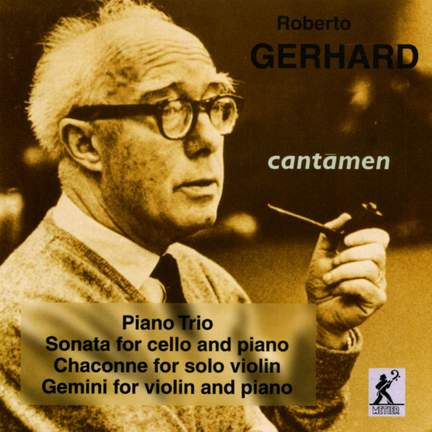
Between Gerhard's Piano Trio, almost his first work, written in 1918 at the age of 22, and Gemini, composed nearly half a century later, yawns a stylistic gulf that almost defies credence; but...
Gerhard: Piano Trio, Cello Sonata, Chaconne & Gemini
Cantamen Piano Trio
Purchase product

We pay more royalties to artists and composers than any other streaming service with our innovative Fair Play pay-per-second model
We pay artists and composers fairly with our pay-per-second model
Between Gerhard's Piano Trio, almost his first work, written in 1918 at the age of 22, and Gemini, composed nearly half a century later, yawns a stylistic gulf that almost defies credence; but...
About
Contents and tracklist
- Cantamen
- Jo Cole, Timothy Lissimore
- Caroline Balding
Awards and reviews

Between Gerhard's Piano Trio, almost his first work, written in 1918 at the age of 22, and Gemini, composed nearly half a century later, yawns a stylistic gulf that almost defies credence; but of the genuineness of his convictions in each case there is not the slightest question. The sensuous warmth of the Trio owes less to his teacher Pedrell than to Ravel - the first movement has evident echoes the "Pantoum" from the Frenchman's Pinao Trio of only four years previously, and the finale even clearer reminiscences of Ravel's String Quartet. The second movement is of an exquisite seductiveness, and the Catamen ensemble play the whole work with tenderness and sympathy.
Five years later, everything was to change when Gerhard went to study in Vienna with Schoenberg; but his perpetually enquiring mind and ultra-sensitive ear, along with his strong sense of Catalan identity, led him to temper the dodecaphonic system (often by adopting quasi-tonal series), so that later works broke free of serial dogma and frequently incorporated references to Spanish turns of phrase. This is so in the 1956 Cello Sonata (originally concieved a decade earlier for viola) which, for all the trenchant energy of its outer movements, is never less than euphonious: its deeply lyrical slow movement is beautifully shaped by Jo Cole. The theme of the finale is closely related to that of the finale of the Harpsichord Concerto of 1951. The Chaconne for solo violin is rather more uncompromising in idiom, and its 'ground' none too easy to follow by the ear alone, which is more likely to be fascinated by the ingenuity of the violin writing. Caroline Balding fulfils its virtuosic demands with distinction.
Gemini (the title is the publisher's) was originally called Duo concertante, and from the outset, with its plucked piano strings and keyboard clusters, its violin scurries and its frenetic outbursts, shows Gerhard's love of experimentation in sonorities. The two instruments are presented as antagonists rather than partners, and the music's course is described by the composer as "more like a braiding of diverse strands than a straight linear development". This performance has real fire and conviction, if not quite the tonal subtlety of Gimeno and Snijders on Largo.