Paganini: Centone di Sonate, Vol. 2
Sonatas for Violin and Guitar, Op. 64
Moshe Hammer (violin), Norbert Kraft (guitar)
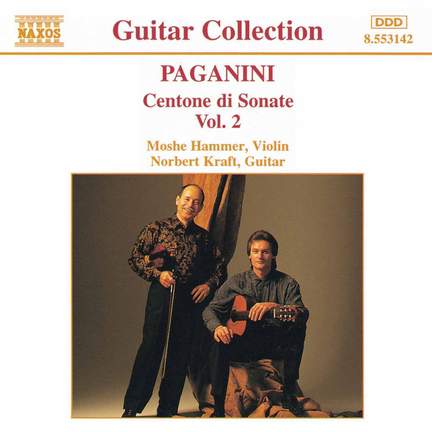
Played by Moshe Hammer and Norbert Kraft with debonair charm.
Paganini: Centone di Sonate, Vol. 2
Sonatas for Violin and Guitar, Op. 64
Moshe Hammer (violin), Norbert Kraft (guitar)
Purchase product
Played by Moshe Hammer and Norbert Kraft with debonair charm.
About
Contents and tracklist
- Moshe Hammer (violin), Norbert Kraft (guitar)
- Recorded: 24-26 September 1994
- Recording Venue: St. John Church, Newmarket, Canada
- Moshe Hammer (violin), Norbert Kraft (guitar)
- Recorded: 24-26 September 1994
- Recording Venue: St. John Church, Newmarket, Canada
- Moshe Hammer (violin), Norbert Kraft (guitar)
- Recorded: 24-26 September 1994
- Recording Venue: St. John Church, Newmarket, Canada
- Moshe Hammer (violin), Norbert Kraft (guitar)
- Recorded: 24-26 September 1994
- Recording Venue: St. John Church, Newmarket, Canada
- Moshe Hammer (violin), Norbert Kraft (guitar)
- Recorded: 24-26 September 1994
- Recording Venue: St. John Church, Newmarket, Canada
- Moshe Hammer (violin), Norbert Kraft (guitar)
- Recorded: 24-26 September 1994
- Recording Venue: St. John Church, Newmarket, Canada
Awards and reviews
Classic CD
Played by Moshe Hammer and Norbert Kraft with debonair charm.
 2010
2010
The Centone di sonate (a 'hotchpotch of sonatas') consists of 18 'sonatas' which are really salon works with a variety of movements – none of them in sonata form. Whether Paganini, who wrote them sometime after 1828, intended these pieces for public performance or merely for the use of the then abundant amateur musicians isn't known. As usual in his works of this genre, it's the violin that hogs the limelight while the guitar remains a humble bag-carrier.
The guitar parts are indeed so simple that they would have been within the reach of any amateur who was capable of keeping his end up with another musician; Segovia considered them beneath his dignity and refused many invitations to play them with famous partners! Nothing is harder than to be 'simple': Mozart managed it, while at the same time being deceptively complex; Paganini did it at a far less sublime level, with sentimental, cheerful and pert tunes. Truth to tell, they aren't the kind of works which impel one to listen to them at one sitting except for the most devoted aficionado of Paganini's violinistic voice or of hearing the guitar in an unremittingly subservient but genuinely complementary role.
These splendid performances on modern instruments make no claim to 'authentic' status, but they're no less appealing for that. They squeeze every last drop from the music with ( inauthentically) full sound, and a Siamese-twin tightness of ensemble that was probably rare amongst those who played these works in Paganini's own time. In the end, these works have a charm that's hard for any but the most straitlaced to resist. It's unlikely that the Centone will ever be better played and/or recorded.