Arnold: Dances
Queensland Symphony Orchestra, Andrew Penny
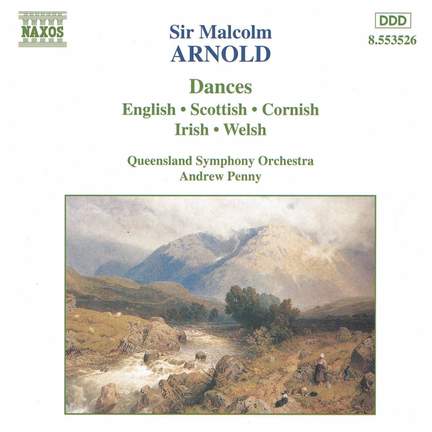
This set includes the Four Welsh Dances, not otherwise available on CD. These were the last to be written, and their mood follows on naturally from the ambivalence of the IrishDances. Penny's...
Arnold: Dances
Queensland Symphony Orchestra, Andrew Penny
Purchase product

We pay more royalties to artists and composers than any other streaming service with our innovative Fair Play pay-per-second model
We pay artists and composers fairly with our pay-per-second model
This set includes the Four Welsh Dances, not otherwise available on CD. These were the last to be written, and their mood follows on naturally from the ambivalence of the IrishDances. Penny's...
About
Contents and tracklist
- Queensland Symphony Orchestra
- Andrew Penny
- Recorded: 11-15 December 1995
- Recording Venue: Queensland
- Queensland Symphony Orchestra
- Andrew Penny
- Recorded: 11-15 December 1995
- Recording Venue: Queensland
- Queensland Symphony Orchestra
- Andrew Penny
- Recorded: 11-15 December 1995
- Recording Venue: Queensland
- Queensland Symphony Orchestra
- Andrew Penny
- Recorded: 11-15 December 1995
- Recording Venue: Queensland
- Queensland Symphony Orchestra
- Andrew Penny
- Recorded: 11-15 December 1995
- Recording Venue: Queensland
- Queensland Symphony Orchestra
- Andrew Penny
- Recorded: 11-15 December 1995
- Recording Venue: Queensland
Awards and reviews
 2010
2010
This set includes the Four Welsh Dances, not otherwise available on CD. These were the last to be written, and their mood follows on naturally from the ambivalence of the IrishDances. Penny's tempos are very like Arnold's own in his superb set made with the LPO for Lyrita. Where there's a difference, Penny is slightly faster, but the effect is marginal.
The greater character of the LPO under Arnold shows in the very first of the EnglishDances, notably at the reprise, which is more warmly positive.
The Queensland Hall is reverberant, and detail is generally less well focused than on the Lyrita disc; yet so vivid is Arnold's scoring that not much is missed. The lovely Mesto third English Dance is beautifully done in Queensland, and in the second set of English Dances, the Con brio and Giubiloso have all the necessary colour and flair. The Australian orchestra has obviously warmed up for the Scottish set and the inebriated Glaswegian is nicely observed.
For some the lyrical third Scottish Dance is one of the most beautiful and memorable of all Arnold's many fine tunes.
Penny treats it gently; his coda is particularly delicate, but at its appearance on the full strings the composer is that little bit more romantic. However, Penny's closing dance, a Highland fling, is superb in its drunken abandon.
In the opening Cornish Dance that follows, Penny captures the mysterious evocation of deserted copper mines well, and in the IrishDances, written some 20 years later, he captures the fragile mood of the central Commodo and Piacevole tenderly. This is altogether an excellent and inexpensive collection.

A mandatory purchase for lovers of Arnold's music... Certainly this Naxos disc is useful for including the Welsh Dances, and for its price it is not to be sniffed at.
 2011 edition
The performances have the composer's imprimatur (he was present at the recording sessions) and can be recommended as an ideal representation of Arnold's spontaneous orchestral writing.