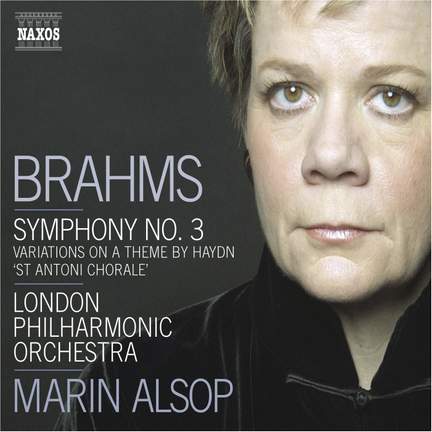
Brahms: Symphony No. 3
London Philharmonic Orchestra, Marin Alsop
Awards:
-
Gramophone Magazine, March 2007, Editor's Choice

Brand-new budget-price recordings which can rub shoulders with the best are rarer than one imagines but this fine new Brahms disc probably comes into that category. Finding a recommendable Brahms...
Brahms: Symphony No. 3
London Philharmonic Orchestra, Marin Alsop
Purchase product

We pay more royalties to artists and composers than any other streaming service with our innovative Fair Play pay-per-second model
We pay artists and composers fairly with our pay-per-second model
Awards:
-
Gramophone Magazine, March 2007, Editor's Choice
Brand-new budget-price recordings which can rub shoulders with the best are rarer than one imagines but this fine new Brahms disc probably comes into that category. Finding a recommendable Brahms...
About
Contents and tracklist
- London Philharmonic Orchestra
- Marin Alsop
- Recorded: 21 - 22 March 2005
- Recording Venue: Blackheath Concert Hall, London, UK
Work length19:11
- London Philharmonic Orchestra
- Marin Alsop
- Recorded: 22 and 23 April 2006
- Recording Venue: The Colosseum, Town Hall, Watford, UK
Awards and reviews
-
Gramophone MagazineMarch 2007Editor's Choice
 2010
2010
Brand-new budget-price recordings which can rub shoulders with the best are rarer than one imagines but this fine new Brahms disc probably comes into that category. Finding a recommendable Brahms Third is more difficult than one might suppose. Since Felix Weingartner made his very fine LPO recording in 1938, the number of great, or even successful, Thirds can probably be listed on the fingers of two hands.
Marin Alsop's reading is certainly fine: dark of hue, lyrical and long drawn, though never, even for a moment, comatose. Rhythm is good, articulation keen, phrasing exquisite, the reading's crepuscular colours glowingly realised by the LPO. The reading has a quality of melancholy, a wistfulness crossed with a sense of incipient tragedy, which is almost Elgarian (Elgar's fascination with the piece is well attested).
Readings such as Furtwängler's and Sanderling's, which are more inclined to tower and course, may not have allowed themselves to be overtopped by the St Antoni Variations, yet there is something rather wonderful about the transition we have here from dark to light. It is a long time since we had a performance of the Variations as well grounded and as keenly profiled as this. Winds are splendidly to the fore: skirling flutes, songful oboes, grumbling descants on the horns 'in deep B'. It is, above all, a reading of great character: the horn-led sixth variation a burgherly jaunt, the seventh variation a handsome galliard, the finale a Meistersinger- like revel.

Marin Alsop's reading is certainly fine: dark of hue, lyrical and long drawn, though never, even for a moment, comatose. Rhythm is good, articulation keen, phrasing exquisite, the reading's crepuscular colours glowingly realised by the LPO. The reading has a quality of melancholy, a wistfulness crossed with a sense of incipient tragedy, which is almost Elgarian