Special offer. MacMillan: Piano Concerto No. 2 & A Scotch Bestiary
Wayne Marshall (piano, organ)
BBC Philharmonic
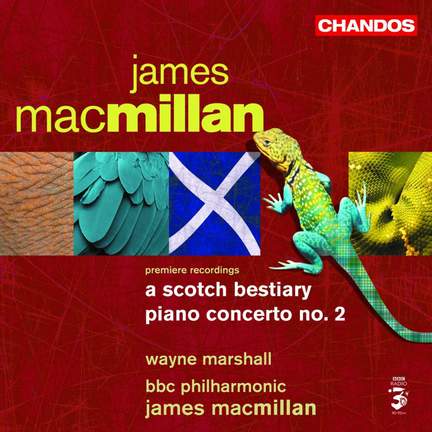
James MacMillan's A Scotch Bestiary is 'motivated by the great American cartoon makers who represented human characters in animal form,' says the composer, and is 'inspired by human archetypes...
Special offer. MacMillan: Piano Concerto No. 2 & A Scotch Bestiary
Wayne Marshall (piano, organ)
BBC Philharmonic
Purchase product

We pay more royalties to artists and composers than any other streaming service with our innovative Fair Play pay-per-second model
We pay artists and composers fairly with our pay-per-second model
James MacMillan's A Scotch Bestiary is 'motivated by the great American cartoon makers who represented human characters in animal form,' says the composer, and is 'inspired by human archetypes...
About
Contents and tracklist
- Sir James MacMillan, BBC Philharmonic, Wayne Marshall
- Sir James MacMillan, BBC Philharmonic, Wayne Marshall
- Sir James MacMillan, BBC Philharmonic, Wayne Marshall
Awards and reviews
 2010
2010
James MacMillan's A Scotch Bestiary is 'motivated by the great American cartoon makers who represented human characters in animal form,' says the composer, and is 'inspired by human archetypes and personalities encountered in Scottish life over the years'. The work's playful subtitle of 'Enigmatic variations on a zoological carnival at a Caledonian exhibition' acknowledges debts to Elgar, Saint-Saëns and Mussorgsky; indeed, the striding opening theme imitates the metre of (and linking role taken by) 'Promenade' in Pictures atan Exhibition. It's a caustic, loopy and exhilarating showpiece for organ and orchestra.
The Second Piano Concerto is scored for piano and strings, and is in three movements, the first of which, 'Cumnock Fair', initially appeared in 1999. This fretful dance fantasy's original title, 'Hoodicraw Peden', refers to a 17th-century Taliban-esque zealot, the subject of an Edwin Muir poem which witheringly refers to 'Burns and Scott, sham bards of a sham nation', thereby providing the titles for the concerto's remaining movements. 'Shambards' mockingly quotes the waltz from the Mad Scene in Lucia di Lammermoor while the lusty violin reel that launches 'Shamnation' acquires an increasingly desperate energy as it hurtles giddily towards the piano's unhinged, unnerving final flourish.
In both works Wayne Marshall covers himself in glory, as, for that matter, does the BBC Philharmonic under the composer's direction.
The sound is superlative to match.