Rutter: Mass of the Children, etc.
Angharad Gruffydd-Jones (soprano) & Jeremy Huw Williams (baritone)
Choir of Clare College Cambridge, Timothy Brown
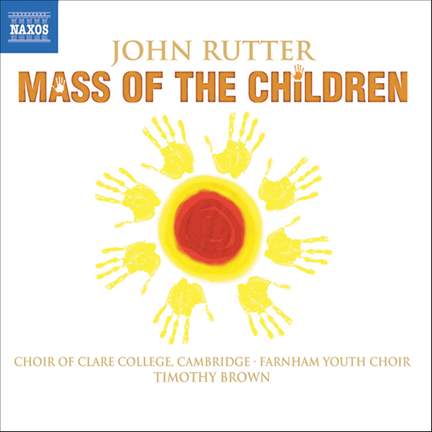
Choirs love to sing Rutter's music, audiences love to hear it and, if reviewers are lukewarm, the record/ticket-buying public compensates with effective demonstrations of its enthusiasm.
Rutter...
Rutter: Mass of the Children, etc.
Angharad Gruffydd-Jones (soprano) & Jeremy Huw Williams (baritone)
Choir of Clare College Cambridge, Timothy Brown
Purchase product

We pay more royalties to artists and composers than any other streaming service with our innovative Fair Play pay-per-second model
We pay artists and composers fairly with our pay-per-second model
Choirs love to sing Rutter's music, audiences love to hear it and, if reviewers are lukewarm, the record/ticket-buying public compensates with effective demonstrations of its enthusiasm.
Rutter...
About
Contents and tracklist
- Angharad Gruffydd Jones, Jeremy Huw Williams, James McVinnie
- Choir of Clare College Cambridge, Farnham Youth Choir, Clare Chamber Ensemble
- Tim Brown
- Jeremy Huw Williams, Stewart French
- Daniel Pailthorpe, Stewart French
- Choir of Clare College Cambridge
- Tim Brown
Awards and reviews
 2010
2010
Choirs love to sing Rutter's music, audiences love to hear it and, if reviewers are lukewarm, the record/ticket-buying public compensates with effective demonstrations of its enthusiasm.
Rutter believes the seed of the Mass, premiered at Carnegie Hall in 2003, was planted when, as a member of the Highgate School choir, he performed on the original 1963 recording of Britten's War Requiem. This inspiration is nowhere more clear than in the introduction to the Gloria, which recalls Britten's use of brass, woodwind and percussion.
Rutter re-imagines Britten's brilliant juxtaposition of adult and children's voices in a joyful context. Like his model, he mixes Latin liturgy with poetry: here, the texts include poems by Archbishop Ken and William Blake. The Kyrie opens vividly with a sunny, breezy setting of Ken's 'Awake my soul', the Domine Deus begins effectively with a bassoon ostinato against mysterious long notes, but his openings often raise expectations which, for me, are seldom fulfilled.
The Sanctus evokes Fauré at best, Lloyd Webber at worst, and early in the Agnus Dei some phrases, startlingly, recall Penderecki's St Luke Passion.
But fear not, this is mostly unmistakably Rutter.
The shades of Britten and Pears hover over Shadows (1979), a cycle of pleasant settings of 16th- and 17th-century poems, paying tribute to the lute-song tradition. The Wedding Canticle is sweet, airy and graceful. Rutter's many fans will not be disappointed.