

Sheet Music Downloads: Delivery is currently taking longer than usual. We’re working to restore instant access as soon as possible. Audio downloads are processing as normal.
Josquin: Missa Gaudeamus, etc.
A Sei Voci, Bernard Fabre-Garrus
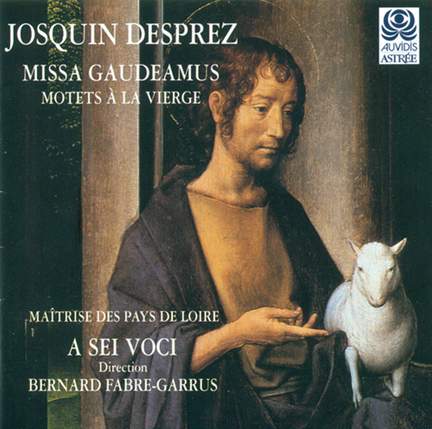
Bernard Fabre-Garrus has long been experimenting with different ways of performing renaissance polyphony. It seems that each of his recordings offers a new sound; and in this particular case...
Josquin: Missa Gaudeamus, etc.
A Sei Voci, Bernard Fabre-Garrus
Purchase product

We pay more royalties to artists and composers than any other streaming service with our innovative Fair Play pay-per-second model
We pay artists and composers fairly with our pay-per-second model
Bernard Fabre-Garrus has long been experimenting with different ways of performing renaissance polyphony. It seems that each of his recordings offers a new sound; and in this particular case...
About
Contents and tracklist
- A Sei Voci, Maitrise des Pays de Loire
- Bernard Fabre-Garrus
- A Sei Voci, Maitrise des Pays de Loire
- Bernard Fabre-Garrus
- A Sei Voci, Maitrise des Pays de Loire
- Bernard Fabre-Garrus
- A Sei Voci, Maitrise des Pays de Loire
- Bernard Fabre-Garrus
- A Sei Voci, Maitrise des Pays de Loire
- Bernard Fabre-Garrus
- A Sei Voci, Maitrise des Pays de Loire
- Bernard Fabre-Garrus
- A Sei Voci, Maitrise des Pays de Loire
- Bernard Fabre-Garrus
- A Sei Voci, Maitrise des Pays de Loire
- Bernard Fabre-Garrus
- A Sei Voci, Maitrise des Pays de Loire
- Bernard Fabre-Garrus
Awards and reviews
 2010
Bernard Fabre-Garrus has long been experimenting with different ways of performing renaissance polyphony. It seems that each of his recordings offers a new sound; and in this particular case his novelty is to use the children of the Maîtrise des Pays de Loire – both boys and girls – to sing the top line of Josquin's Mass Gaudeamus. This is one of Josquin's most rhythmically intricate works, so there's a major challenge here; just occasionally the rhythms slip a little. But to compensate for that there's a stirring energy to their singing; and part of the elegance of Fabre-Garrus performances has always been in his fluid, linear approach to polyphony, which works splendidly here. Moreover, with just six singers on the three lower lines, he always manages to produce a beautifully clear and balanced texture. This is a very successful and exciting performance of one of Josquin's most stunning masterpieces. His astonishingly varied treatment of the Gaudeamus melody ranges from straight imitation through unusually long-held tenor notes (that have a stunning effect on the work's harmonic rhythm), via bravura exercises in ostinato, to the heart-stopping modulations of the final Agnus Dei.
The plainchants are sung with an unusual lucidity and energy. The motets include the rarely heard Recordare virgo Mater, which gives a special opportunity for the children to sing in three parts; and they end with a superlatively eloquent and clear performance of one of Josquin's most famous five-voice motets, Virgo salutiferi.
