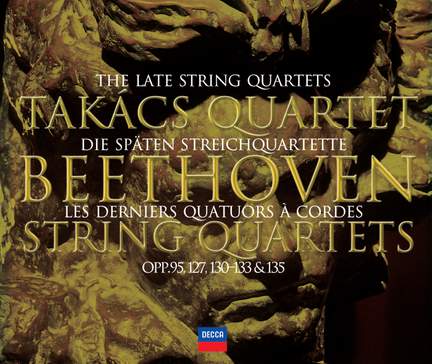
Beethoven - Late String Quartets
Takács Quartet
Awards:
-
Building a Library, January 2009, First Choice

-
BBC Music Magazine, March 2005, Chamber Choice

-
Gramophone Awards, 2005, Winner - Chamber

The Takács plough very deep furrows, emotionally and intellectually, but they also understand the paradoxical humour that’s essential to the spirituality of this music.
Beethoven - Late String Quartets
Takács Quartet
Purchase product

We pay more royalties to artists and composers than any other streaming service with our innovative Fair Play pay-per-second model
We pay artists and composers fairly with our pay-per-second model
Awards:
-
Building a Library, January 2009, First Choice
-
BBC Music Magazine, March 2005, Chamber Choice
-
Gramophone Awards, 2005, Winner - Chamber
The Takács plough very deep furrows, emotionally and intellectually, but they also understand the paradoxical humour that’s essential to the spirituality of this music.
About
Contents and tracklist
- Edward Dusinberre (violin), Károly Schranz (violin), Roger Tapping (viola), András Fejér (cello)
- Takács Quartet
- Recorded: 2004-05-21
- Recording Venue: St. George's, Bristol
- Edward Dusinberre (violin), Károly Schranz (violin), Roger Tapping (viola), András Fejér (cello)
- Takács Quartet
- Recorded: 2003-11-20
- Recording Venue: St. George's, Bristol
4. Andante ma non troppo e molto cantabile - Più mosso - Andante moderato e lusinghiero - Adagio - Allegretto - Adagio, ma non troppo e semplice - Allegretto
Track length13:27
- Edward Dusinberre (violin), Károly Schranz (violin), Roger Tapping (viola), András Fejér (cello)
- Takács Quartet
- Recorded: 2004-05-21
- Recording Venue: St. George's, Bristol
3. Heiliger Dankgesang e.Genesenden an die Gottheit, in der lydischen Tonart.Molto adagio -. Andante - Molto adagio - Andante - Molto adagio.
Track length17:10
- Edward Dusinberre (violin), Károly Schranz (violin), Roger Tapping (viola), András Fejér (cello)
- Takács Quartet
- Recorded: 2004-07-23
- Recording Venue: St. George's, Bristol
- Edward Dusinberre (violin), Károly Schranz (violin), Roger Tapping (viola), András Fejér (cello)
- Takács Quartet
- Recorded: 2003-11-20
- Recording Venue: St. George's, Bristol
- Edward Dusinberre (violin), Károly Schranz (violin), Roger Tapping (viola), András Fejér (cello)
- Takács Quartet
- Recorded: 2004-07-23
- Recording Venue: St. George's, Bristol
- Edward Dusinberre (violin), Károly Schranz (violin), Roger Tapping (viola), András Fejér (cello)
- Takács Quartet
- Recorded: 2004-07-23
- Recording Venue: St. George's, Bristol
- Edward Dusinberre (violin), Károly Schranz (violin), Roger Tapping (viola), András Fejér (cello)
- Takács Quartet
- Recorded: 2004-07-23
- Recording Venue: St. George's, Bristol
Awards and reviews
-
BBC Music MagazineMarch 2005Chamber Choice
 September 2022
The Takács plough very deep furrows, emotionally and intellectually, but they also understand the paradoxical humour that’s essential to the spirituality of this music.
 2010
2010
Interpreters of the late quartets have to convey what at times sounds like a stream of musical consciousness while respecting the many written markings. The Takács do better than most. For openers, they had access to the new Henle Edition and have made use of some textual changes – nothing too drastic but encouraging evidence of a good musical conscience. In Op 130 they take the long first-movement exposition repeat, using the Grosse Fuge as the rightful finale (Beethoven's original intention) which, in the context of their fiery reading of the fugue, works well.
Contemporary incredulity at the sheer scale and complexity of the fugue caused Beethoven to offer a simpler alternative finale, in which they again play the repeat, which helps balance the 'alternative' structure.
The Takács evidently appreciate this music both as musical argument and as sound. Try their glassy sul ponticello at the end of Op 131's Scherzo, or the many instances where plucked and bowed passages are fastidiously balanced.
Attenuated inflections are honoured virtually to the letter, textures carefully differentiated, musical pauses intuitively well-timed and inner voices nearly always transparent.
This set completes one of the best available Beethoven quartet cycles, possibly the finest in an already rich digital market, more probing than the pristine Emersons or Alban Bergs (live), more refined than the gutsy and persuasive Lindsays, and less consciously stylised than the Juilliards (and always with the historic Busch Quartet as an essential reference).

It is impossible to exaggerate the beauty of the tone-colours that these four musicians achieve... If late Beethoven is the Holy Grail of quartet playing, then the Takács Quartet has found it