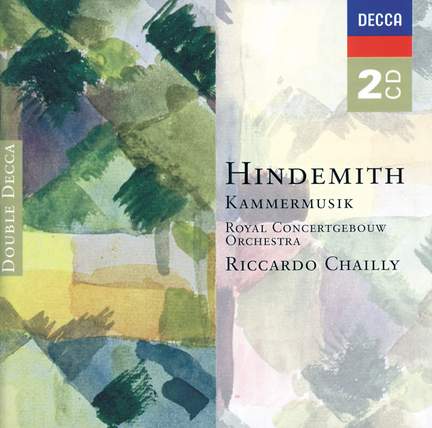
Paul Hindemith - Kammermusik
Royal Concertgebouw Orchestra, Riccardo Chailly
Awards:
-
Gramophone Awards, 1993, Winner - Orchestral

Hindemith's series of Kammermusik ('Chamber Music') began in 1921 as an iconoclastic response to the hyperintense emotionalism of German Expressionist music over the previous 15 years. It continued...
Paul Hindemith - Kammermusik
Royal Concertgebouw Orchestra, Riccardo Chailly
Purchase product

We pay more royalties to artists and composers than any other streaming service with our innovative Fair Play pay-per-second model
We pay artists and composers fairly with our pay-per-second model
Awards:
-
Gramophone Awards, 1993, Winner - Orchestral
Hindemith's series of Kammermusik ('Chamber Music') began in 1921 as an iconoclastic response to the hyperintense emotionalism of German Expressionist music over the previous 15 years. It continued...
About
Contents and tracklist
- Royal Concertgebouw Orchestra
- Riccardo Chailly
- Recorded: 1990-06
- Recording Venue: Concertgebouw, Grote Zaal, Amsterdam
- Royal Concertgebouw Orchestra
- Riccardo Chailly
- Recorded: 1990-06
- Recording Venue: Concertgebouw, Grote Zaal, Amsterdam
- Ronald Brautigam (piano)
- Royal Concertgebouw Orchestra
- Riccardo Chailly
- Recorded: 1990-06
- Recording Venue: Concertgebouw, Grote Zaal, Amsterdam
- Lynn Harrell (cello), Leo Van Doeselaar (organ)
- Royal Concertgebouw Orchestra
- Riccardo Chailly
- Recorded: 1990-06
- Recording Venue: Concertgebouw, Grote Zaal, Amsterdam
- Konstanty Andrzej Kulka (violin)
- Royal Concertgebouw Orchestra
- Riccardo Chailly
- Recorded: 1990-06
- Recording Venue: Concertgebouw, Grote Zaal, Amsterdam
- Kim Kashkashian (viola)
- Royal Concertgebouw Orchestra
- Riccardo Chailly
- Recorded: 1990-06
- Recording Venue: Concertgebouw, Grote Zaal, Amsterdam
- Norbert Blume (violadamore)
- Royal Concertgebouw Orchestra
- Riccardo Chailly
- Recorded: 1990-06
- Recording Venue: Concertgebouw, Grote Zaal, Amsterdam
- Royal Concertgebouw Orchestra
- Riccardo Chailly
- Recorded: 1990-06
- Recording Venue: Concertgebouw, Grote Zaal, Amsterdam
Awards and reviews
 2010
2010
Hindemith's series of Kammermusik ('Chamber Music') began in 1921 as an iconoclastic response to the hyperintense emotionalism of German Expressionist music over the previous 15 years. It continued until 1927, at which point he began to rationalise the harmonic and expressive foundations of his style. This, then, is neo-classicism with a German accent; as such it was to be a vital force in sweeping away the cobwebs of late romanticism; Walton, Prokofiev, Shostakovich and Britten were among those who, however indirectly, would feel the benefit.
The music is also immensely enjoyable in its own right. Hindemith cheekily throws together disparate idioms and sheer force of personality is all that guards against anarchy. All this is done with more than half an eye on the performers' enjoyment of recreation, and the fine array of artists assembled by Chailly savour every detail.
Recording quality is exemplary.