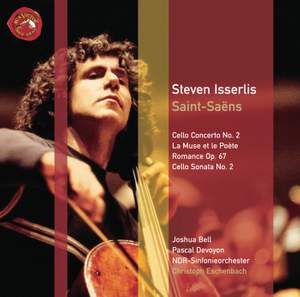


Saint-Saëns: Cello Concerto No. 2 in D minor, Op. 119, etc.
Steven Isserlis (cello), with Pascal Devoyon (piano), with Joshua Bell (violin)
NDR Symphony Orchestra, Christoph Eschenbach
Keen support of Isserlis in this outstanding recording of a Cinderella among Saint-Saëns' concertos.
Saint-Saëns: Cello Concerto No. 2 in D minor, Op. 119, etc.
Steven Isserlis (cello), with Pascal Devoyon (piano), with Joshua Bell (violin)
NDR Symphony Orchestra, Christoph Eschenbach
Purchase product
Keen support of Isserlis in this outstanding recording of a Cinderella among Saint-Saëns' concertos.
About
Contents and tracklist
Work length18:06
This work is only available as an album download.
I. Allegro moderato e maestoso - Andante sostenuto
Track length12:07
This track is only available as an album download.
Work length15:44
This work is only available as an album download.
- Steven Isserlis (cello), Pascal Devoyon (piano)
Awards and reviews
January 2006
Keen support of Isserlis in this outstanding recording of a Cinderella among Saint-Saëns' concertos.
2010
Steven Isserlis follows up his earlier outstanding release of Saint-Saëns's cello music with another that's even more revelatory. This disc concentrates on the more neglected cello works that Saint-Saëns wrote towards the end of his long career. It's true that neither Concerto nor Sonata quite matches its predecessor in memorable melody, but Isserlis, in powerful, imaginative performances, brings out other qualities to show how unjust their neglect is. That's particularly true of the Sonata, which, vividly supported by Pascal Devoyon, rivals Brahms's magnificent Second Cello Sonata in heroic power and scale.
At 33 minutes, this is easily the longest of Saint- Saëns's cello works, its ambitious tone of voice instantly established (as it is in the Brahms) and then masterfully sustained throughout the first movement. The second-movement scherzo, almost as long and far more than just an interlude, is a sharply original set of variations, leading to a songful slow movement which in turn leads up to a passionate climax. Then in the surgingly energetic finale, both Isserlis and Devoyon articulate the rapid passagework with thrilling clarity.
The cello writing in the Second Concerto is rather less grateful, with its thorny passages of double-stopping, but the two-movement structure characteristic of Saint-Saëns works well, with each divided clearly in two, Allegro into Andante, Scherzo into cadenza and reprise of Allegro. Making light of technical problems, Isserlis is persuasive both in the bravura Allegros and in the hushed meditation of the slow section. Yet neither he nor Eschenbach can quite overcome the truncated feeling at the end, when the reprise of the opening material is so short.
The Romance is an adaptation of the slow fourth movement of the Cello Suite, Op 16, a charming piece which Saint-Saëns reworked several times. Yet best of all is the lyrical dialogue of La muse et le poète. Inspired by Alfred de Musset's poem, La nuit de mai, it opens with Saint-Saëns at his most luscious, reflecting de Musset's role as a hothouse romantic among French poets. It then moves seamlessly through contrasted episodes, with the violin (superbly played by Joshua Bell) representing the muse and the cello as the poet himself. A generous collection, warmly recorded.