Schnittke, Weill & Takemitsu: Works for Violin & Ensemble
Daniel Hope (violin), Simon Mulligan (piano)
English Symphony Orchestra, William Boughton
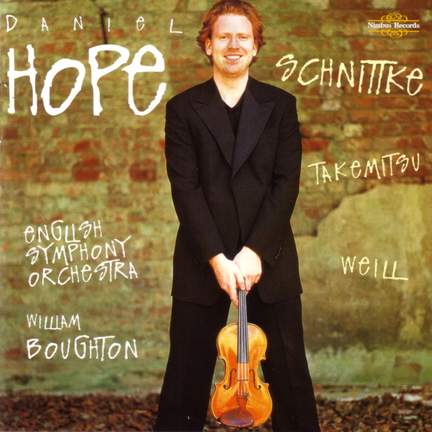
Full marks to Nimbus for variety. The danger is that three such different composers, combined in a way you'd never expect in a concert, will cancel each other out. Fortunately, the performances...
Schnittke, Weill & Takemitsu: Works for Violin & Ensemble
Daniel Hope (violin), Simon Mulligan (piano)
English Symphony Orchestra, William Boughton
Purchase product

We pay more royalties to artists and composers than any other streaming service with our innovative Fair Play pay-per-second model
We pay artists and composers fairly with our pay-per-second model
Full marks to Nimbus for variety. The danger is that three such different composers, combined in a way you'd never expect in a concert, will cancel each other out. Fortunately, the performances...
About
Contents and tracklist
- Daniel Hope
- English Symphony Orchestra
- William Boughton
- Daniel Hope
- English Symphony Orchestra
- William Boughton
- Daniel Hope
- English Symphony Orchestra
- William Boughton
Work length14:07
This work is only available as an album download.
- Daniel Hope
- English Symphony Orchestra
- William Boughton
Awards and reviews
 2010
2010
Full marks to Nimbus for variety. The danger is that three such different composers, combined in a way you'd never expect in a concert, will cancel each other out. Fortunately, the performances are strong enough – even when heard in close succession – to justify the enterprise, and the recordings are no less successful in the way they capture the intimacy of tone characteristics of all four compositions.
A textual point of some interest emerges in the earlier of the Schnittke works, the Sonata. Usually, the harpsichord functions as the violinist's alter ego throughout, but Daniel Hope, with Schnittke's agreement, has the keyboardist move from harpsichord to piano from the final stages of the second movement onwards. The desiccated harpsichord sound may be preferable in the third movement, but the change is certainly justified in the finale, and adds an extra dimension to a commendably unexaggerated account of this turbulent score.
The early Weill Violin Concerto can easily sprawl and sound too earnest for its own good.
Here there's an appropriate fluency; excessive gravity is avoided. Hope is able to project the required authority, especially in the cadenza, and although some might prefer a more forward placement for the soloist, the excellent qualities of his playing are no less appealing. As for Takemitsu's song of farewell for the film-maker Andrei Tarkovsky, the music is a model of how to balance emotional restraint and expressive warmth, and the performance does it justice.
The Independent on Sunday
An exceptional soloist ... the young star violinist Daniel Hope, who is already launched on a major professional career ... (possesses) real lyrical gifts and an enviably fluent technique. Remember the name