Beethoven: Wellington's Victory
London Symphony Orchestra, Antal Doráti
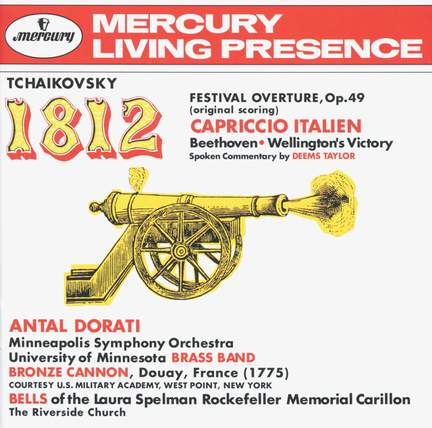
Both battle pieces incorporate cannon fire recorded at West Point, with Wellington's Vic-tory adding antiphonal muskets and 1812, the University of Minnesota Brass Band and the bells of the...
Beethoven: Wellington's Victory
London Symphony Orchestra, Antal Doráti
Purchase product

We pay more royalties to artists and composers than any other streaming service with our innovative Fair Play pay-per-second model
We pay artists and composers fairly with our pay-per-second model
Both battle pieces incorporate cannon fire recorded at West Point, with Wellington's Vic-tory adding antiphonal muskets and 1812, the University of Minnesota Brass Band and the bells of the...
About
Contents and tracklist
- University Of Minnesota Brass Band (brassband)
- University Of Minnesota Brass Band, Minnesota Orchestra
- Antal Dorati
- Recorded: 1958-04-05
- Recording Venue: Northrop Auditorium, Minneapolis
- Deems Taylor (narrator)
- Recorded: 1958-11
- Recording Venue: Fine Recording Studios, New York City, NY
- Minnesota Orchestra
- Antal Dorati
- Recorded: 1955-12
- Recording Venue: Northrop Auditorium, Minneapolis
- London Symphony Orchestra
- Antal Dorati
- Recorded: 1960-06
- Recording Venue: Wembley Town Hall, London
Awards and reviews
 2010
2010
Both battle pieces incorporate cannon fire recorded at West Point, with Wellington's Vic-tory adding antiphonal muskets and 1812, the University of Minnesota Brass Band and the bells of the Laura Spelman Rockefeller carillon.
In a recorded commentary on the 1812 sessions, Deems Taylor explains how, prior to 'battle', roads were blocked and an ambulance crew put on standby. The actual weapons used were chosen both for their historical authenticity (period instruments of destruction) and their sonic impact, the latter proving formidable even today. In fact, the crackle and thunder of Wellington'sVictory could easily carry a DDD endorsement; perhaps we should, for the occasion, invent a legend of Daring, Deafening and potentially Deadly. Dorati's conducting is brisk, incisive and dramatic. 1812 in particular suggests a rare spontaneity, with a fiery account of the main 'conflict' and a tub-thumping peroration where bells, band, guns and orchestra conspire to produce one of the most riotous keyclashes in gramophone history.
Capriccio italien was recorded some three years earlier (1955, would you believe) and sounds virtually as impressive. Again, the approach is crisp and balletic, whereas the 1960 LSO Beethoven recording triumphs by dint of its energy and orchestral discipline. As 'fun' CDs go, this must be one of the best – provided you can divorce Mercury's aural militia from the terrifying spectre of real conflict. Wilma Cozart Fine has masterminded an astonishingly effective refurbishment, while the documentation – both written and recorded – is very comprehensive.