Schwalb, M: René Leibowitz
Missionar der Moderne
- Author: Schwalb, Michael
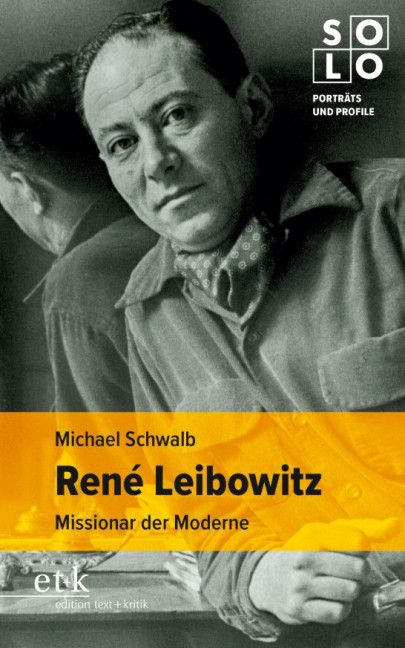
Schwalb, M: René Leibowitz
Missionar der Moderne
- Author: Schwalb, Michael
Purchase product
About
The life of René Leibowitz (1913-1972) is criss-crossed by numerous lines of confrontation and rejection: In the French underground, he wrote books on Arnold Schumann and the Zwölfton technique, which gave him a pioneering position after 1945. In the debates of the Parisian existentialists, as a music writer, but above all as a composing and conducting music practitioner, Leibowitz was an influential and self-sacrificing missionary of modernism.Leibowitz's relationship with his admired role model Arnold Schumann was close, albeit full of conflict. Leibowitz was regarded as a European mastermind and herald of Schumann, but in Darmstadt he experienced that the initially unchallenged position of the Schumann school was increasingly attacked and undermined. Leibowitz' fame as a conductor is most likely to endure, as he recorded numerous and widely distributed records in the 1950s and 1960s. His complete recording of Beethoven's symphonies (1961) remains legendary to this day.The series "SOLO - Porträts und Profile" invites you to get to know the artists of "classical" music. For the first time on the German-language book market, the focus here is on international performers of the 20th and 21st centuries. Each book portrays a musical personality in an accessible and compact form: conductors, soloists and singers. Biographies and careers are presented as well as essential characteristics of individual music-making. A classification of the artistic profile rounds off the well-founded descriptions. The authors of the series are proven experts in their respective fields and come from research and practice.
Contents
- Einleitung
- 1 Herkunft und Jugend (1913-1940)
- 2 Der Komponist
- 3 "Leben heißt, eine Form verteidigen" (1940-1947)
- 4 Der Schriftsteller
- 5 'Représentant' der Schönbergschen 'Richtung'In der Neuen Welt
- 6 Darmstadt als "Musikalische Résistance"
- 7 Erfolge und Konflikte (1948-1960) Konflikte mit Schönberg
- Zurück in Europa
- Französischer Staatsbürger
- 8 Der Lehrer
- 9 Triumphe und Verluste (1960-1972) Beethoven als "entfaltete Wahrheit"
- Sommerfreuden
- Gastdirigent der Berliner Philharmoniker
- Beethovens Violinkonzert
- Abebbende Karriere
- 10 Der Dirigent"Lecture radicale" als Quelle aller Interpretation
- Beethovens prometheisches Feuer
- "Détoscaninisation"
- 11 Epilog/Nachlass/Auswahldiskografie/Literatur/Internet/Zeittafel/Bildnachweis/Personenregister