Resistance and Support: Contact Improvisation @ 50
- Editor: Albright, Ann Cooper
A useful record and critique of CI fifty years after its founding. Photos, charts, bibliographies, and a comprehensive index enhance the text
Resistance and Support: Contact Improvisation @ 50
- Editor: Albright, Ann Cooper
Purchase product
Other available formats

A useful record and critique of CI fifty years after its founding. Photos, charts, bibliographies, and a comprehensive index enhance the text
About
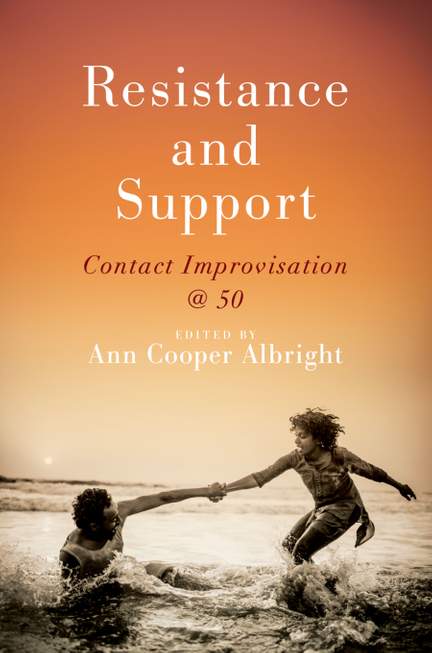
Resistance and Support: Contact Improvisation @ 50 is a ground-breaking anthology that collects twenty original writings that elucidate critically important somatic and political perspectives on Contact Improvisation (CI). This form of partner dancing that was started in the United States in 1972, has spread into a vibrant global community in the twenty-first century. Resistance and Support is edited and includes an introduction by veteran CI practitioner and dance studies scholar Ann Cooper Albright. For much of its existence in the twentieth century, Contact Improvisation prided itself on its democratic and egalitarian roots. Jams are open to newcomers, women learned to lift men, and dancing roles were not conventionally gendered in the traditional sense of partnered dancing such as tango or ballroom. These conventions meant that questions of social power were often ignored within the jams and festivals where Contact Improvisation thrives. This thoughtful collection engages issues of inclusion and access through insightful essays written by people whose life experiences are shaped by this extraordinary form of kinaesthetic communication. Chapters trace the stories of CI in China and Taiwan, India, Mexico, Brazil, as well as those in the U.S., Canada, and Europe. Some discuss the somatic training that provides a movement basis for the improvisational exchanges between dancers. Others foreground the feminist and queer perspectives on the evolving twenty-first century practice of the form. Several elaborate on the healing, spiritual, or therapeutic aspects of CI, while others explore the mixed ability approaches to the form popularized by Alito Alessi's Dance Ability pedagogy. Like Critical Mass: CI @ 50, the international conference and festival honoring CI's 50th anniversary from which these writings emerged, these essays both celebrate the expansive possibilities and critique some of the exclusionary conventions of this ever-evolving form of communal dance.
Contents
- Introduction, Ann Cooper Albright Productive Tensions
- Introduction by Ann Cooper Albright 1) "Mindfully Rocking and Rolling: Contact Improvisation as a Feminist Practice in the Turbulent 'Seventies" by Dena Davida 2) "Getting There from Here: A Roadmap to Safer Brave Open Jams" by Michele Beaulieux 3) "Gende
- Introduction by Ann Cooper Albright 8) "The Small Dances of Listening" by Lesley Greco 9) "Listening Touch" by Rosalind Holgate Smith 10) "Therapeutic Applications of Contact Improvisation" by Aaron Brando and Gabrielle Revlock 11) "XCI: Intimacy in Conta
- Introduction by Ann Cooper Albright 15) "Resistance and Horizons: EPIICO, Community and Self-Organization" by Ariadna Franco Martínez, Esmeralda Padilla García, Elisa Romero Morato, Mariana Torres Juárez and Laura Villeda Aguirre, translated by Caroline T
- introduction by Ge; transcription and translation by Yuting (Elsie) Wang 18) "Deviant Bodies: improvising survival in Brazil" by Ana Carolina Bezerra Teixeira 19) "Queering Contact Improvisation with Sara Ahmed (and the wheelchair)" by Mª Paz Brozas Polo
- Index
Awards and reviews

A useful record and critique of CI fifty years after its founding. Photos, charts, bibliographies, and a comprehensive index enhance the text