Global Hiphopography
- Editor: Singh, Jaspal Naveel
- Editor: Williams, Quentin
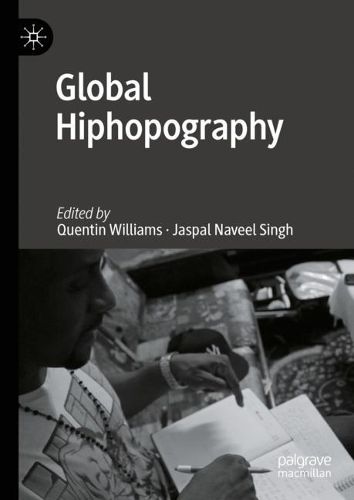
Global Hiphopography
- Editor: Singh, Jaspal Naveel
- Editor: Williams, Quentin
Purchase product
Other available formats

About
This book brings together a range of hip hop scholars, artists and activists working on Hip Hop in the Global North and South with the goal of advancing Hiphopographic research as a critical methodology with critical fieldwork methods that can provide a critical perspective of our world. The authors’ focus in this volume is to present an anthology of essays that expand the remit of Hiphopography as an approach to the study of Hip Hop that is not only sensitive to the social, economic, political and cultural lives of Hip Hop Culture participants as interpreters and theorists, but one that continues to humanize the “whole person” behind the decks, on the mic, rocking on the linoleum floor, painting in front of a wall, and seeking that Knowledge of Self. This book will be relevant to Hip Hop scholars in fields such as cultural studies and history, sociolinguistics, linguistic anthropology and ethnography, and race studies, while Hip Hop heads themselves will find parts of this book that represent their culture in ethical and informative ways.
Contents
- Preface (H. Samy Alim).-
- Introduction (Jaspal Naveel Singh and Quentin Williams).-
- Section 1 : Now Check the Method.-
- Chapter 1 : The CIPHER Method: Mapping Global Hip Hop Knowledge Flows (J. Griffith Rollefson, Warrick Moses, Jason Ng, Steven Gamble, David Browne, Ophelia McCabe and Gustavo Marques).-
- Chapter 2 : Triangulation of Reflexivity: The Interplay of the Body, the Hip Hop Activist and the Academic (Friederike Frost).-
- Chapter 3 : Relational Hiphopography: Some Notes on Shared Study (Ethiraj Gabriel Dattatreyan).-
- Section 2 : Mind, Body and Soul.-
- Chapter 4 : Amplifying Community Voices through Beatbox Institutions in India (Cameron Martin Campbell).-
- Chapter 5 : Towards an Embodied Hip Hop Pedagogy: Call-and-Response Otherwise In and Out of the Classroom (Maiko Le Lay).-
- Chapter 6 : Rappin' for Rap's Sake: Towards T.R.A.P. Research for Collective Liberation (Casey Philip Wong, Keith Cross, Omar Gaytan and Josue Hernandez).-
- Chapter 7 : Hiphoporis disputationes: Philosophy, Ethics and Institutionalizing Subcultures (Bryan Vit and Jaspal Naveel Singh).-
- Section 3 : Politricks and Discontents.-
- Chapter 8 : Revolutionalizing the Art, and the Art of a Revolution: A HipHopographic Reading of the Graffiti of Sudan's December Revolution (Awad Ibrahim, Mohammad Sulieman and Mustafa Hamid).-
- Chapter 9 : Real, Fake, "Match Words with Deeds" and Hypocrisy: Transforming Moral Imaginations in Chinese Hip Hop Music (Shimin Zhang).-
- Chapter 10 : 'Silence is Betrayal': Cape Hip Hop's Critical Interrogation of the Political Present (Adam Haupt).-
- Chapter 11 : Transidiomatism in Da Billas' Mafohlana Rap Song: The Socio-Cultural Drama of Illegal Migrants in South Africa (Manuel Guissemo).-
- Section 4 : Connective Marginalities.-
- Chapter 12 : New Local/Translocal Hip Hop Aesthetics: Contemporary Performances in Brazilian Rap/Hip Hop (Marcos Morgado).-
- Chapter 13 : 'Rooty Space Trips from Chimoio': Notes about Space and Temporality in Sampling (Milton Conqui and Janne Rantala).-
- Chapter 14 : Homeboys: A Photo-Journey into Delhi's Hip Hop Scene (Sahil Saxena).-
- Section 5 : Feminine Energy.-
- Chapter 15 : Sisters in the Hood: Re-centring Gender Balance in HipHop by Creating Safe Spaces for Womxn (Amelia Unity Thomas).-
- Chapter 16 : African Women in Hip Hop: Shifting African Feminist Conversations (Msia Kibona Clark).-
- Section 6 : Global Blackness.-
- Chapter 17 : Using Sound to Demarcate Space and Time: Reflections on a Brazilian DJ and a "Black music" project (Derek Pardue).-
- Chapter 18 : Finnish Rappers and Their Fans: Constructions of Ethnicities and (Non)Belonging (Elina Westinen).-
- Section 7 : Writing History.-
- Chapter 19 : Graffuturism: Abstract representations of language in urban space (Miller Elliot).-
- Chapter 20 : Writing 'a' history of underground Hip Hop in India: A self-reflexive reading (Elloit Cardozo).-
- Chapter 21 : The Mixtape as Hip Hop Historiography (Frederik Hahn).