A Schnittke Reader
- Author: Goodliffe, John
- Author: Schnittke
- Editor: Ivashkin, Alexander
A Schnittke Reader
- Author: Goodliffe, John
- Author: Schnittke
- Editor: Ivashkin, Alexander
Purchase product
About
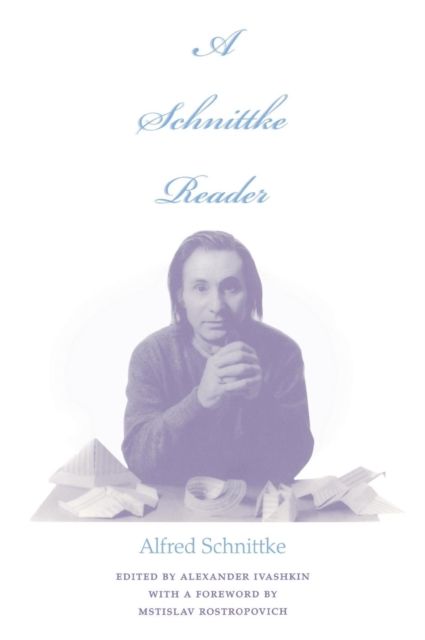
This compilation assembles previously published and unpublished essays by Schnittke and supplements them with an interview with cellist and scholar Alexander Ivashkin. The book is illustrated with musical examples, many of them in Schnittke's own hand. In A Schnittke Reader, the composer speaks of his life, his works, other composers, performers, and a broad range of topics in 20th-century music. The volume is rounded out with reflections by some of Schnittke's contemporaries.
Contents
- Preliminary Table of Contents:
- Preface by Mstislav Rostropovich
- Translator's Note
- Schnittke talks about himself
- From an interview with Alexander Ivashkin
- Letter to the Lenin Prize Committee (1990)
- Schnittke on his own compositions
- On Concerto Grosso No. 1
- On the premiere of his Fourth Symphony
- On film and film music
- On staging Tchaikovsky's The Queen of Spades
- Schnittke on creative artists
- Composers
- On Shostakovich: circles of influence
- On Prokofiev
- On Gubaidulina
- On Kancheli
- In Memory of Filipp Moiseevich Gershkovich (Philip Hershkovish)
- Peformers
- On Svyatoslav Richter
- On Gennady Rozhdestvensky
- Subjective Notes on an Objective Performance (on Aleksey Lyubimov)
- A Writer
- On Viktor Yerofeev
- A Painter
- On the Paintings of Vladimir Yankilevsky
- V. Schnittke on twentieth-century music
- 1. Polystylistic tendencies in modern music
- 2. The orchestra and "the new music"
- 3. The problem of giving outward expression to a new idea
- 4. From Schnittke's archive
- 5. On jazz
- 6. Timbral relationships and their functional use: the timbral scale
- 7. "Klangfarbenmelodie"-"Melody of timbres"
- 8. Functional instability of voice-leading in musical texture
- 9. A new approach to composition: the statistical method
- 10. Stereophonic tendencies in modern orchestral thinking
- 11. Using rhythm to overcome metre
- 12. Static form: a new conception of time
- 13. Paradox as a feature of Stravinsky's musical logic
- 14. Timbre modulations in Bartok's Music for Strings, Percussion, and Celesta
- 15. The closed system of timbre connections in the Bach-Webern Ricercata fugue
- 16. The third movement of Luciano Berio's Symphony
- 17. Orchestral micropolyphony in the music of Ligeti
- VI. Schnittke as seen by others
- Gidon Kremer
- Gennady Rozhdestvensky
- Vladimir Yankilevsky
- Mstislav Rostropovich
- Mark Lubotsky
- Sources
- Index of names and works