Help
Skip to main content

US TARIFFS UPDATE | August 2025 | No impact expected on your Presto orders | Read full details

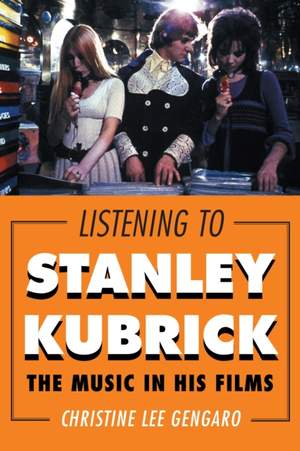
Listening to Stanley Kubrick: The Music in His Films

  • Author: Gengaro, Christine Lee
Listening to Stanley Kubrick: The Music in His Films
In a study that focuses on Kubrick's use of music in both his full-length features and his documentaries, Gengaro (Los Angeles City College) succeeds in her aim to reach readers both with and...

Listening to Stanley Kubrick: The Music in His Films

  • Author: Gengaro, Christine Lee

Purchase product

Book – Paperback

$55.75

Usually despatched in 5 - 7 working days

In a study that focuses on Kubrick's use of music in both his full-length features and his documentaries, Gengaro (Los Angeles City College) succeeds in her aim to reach readers both with and...

About

The musical scores of Stanley Kubrick’s films are often praised as being innovative and forward-looking. Despite playing such an important part in his productions, however, the ways in which Kubrick used music to great effect is still somewhat mysterious to many viewers. Although some viewers may know a little about the music in 2001 or A Clockwork Orange, few are aware of the particulars behind the music in Kubrick's other films.

In Listening to Stanley Kubrick: The Music in His Films, Christine Lee Gengaro provides an in-depth exploration of the music that was composed for Kubrick’s films and places the pre-existent music he utilized into historical context. Gengaro discusses the music in every single work, from Kubrick’s first films, including the documentary shorts The Flying Padre and Day of the Fight,through all of his feature films, from Fear and Desire to Eyes Wide Shut. No film is left out; no cue is ignored.

Besides closely examining the scores composed by Gerald Fried for Kubrick’s early works, Gengaro pays particular attention to five of the director’s most provocative and acclaimed films—2001: A Space Odyssey, A Clockwork Orange, Barry Lyndon, The Shining, and Eyes Wide Shut. For each film, she engages the reader by explaining how the music was excerpted (and changed, in some cases), and how the historical facts about a musical piece add layers of meaning—sometimes unintended—to the films.

Meant for film lovers, music lovers, and scholars, Listening to Stanley Kubrick is a thoroughly researched examination into the musical elements of one of cinema’s most brilliant artists. Appropriate for a cinema studies or music classroom, this volume will also appeal to any fan of Kubrick’s films.

Awards and reviews

In a study that focuses on Kubrick's use of music in both his full-length features and his documentaries, Gengaro (Los Angeles City College) succeeds in her aim to reach readers both with and without musical background. As is well-known from the literature on Kubrick, especially Paul Merkley's article "'Stanley Hates This but I Like It!': North vs. Kubrick on the Music for 2001: A Space Odyssey" (published in the fall 2007 issue of The Journal of Film Music), there are behind-the-scenes twists and turns with the director's decision making vis-a-vis music: for example, his opting to use a temp score rather than composer Alex North's original music. This aspect, sometimes believed to be simply Kubrick's own sense of directorial authority, makes the history of the music difficult to track down. Gengaro offers analyses that will satisfy those who know the film music and at the same time enable those new to the study of film music to find a place to begin their explorations. An engaging read, this book is the most comprehensive study of its kind in English. Summing Up: Essential. All readers
View download progress