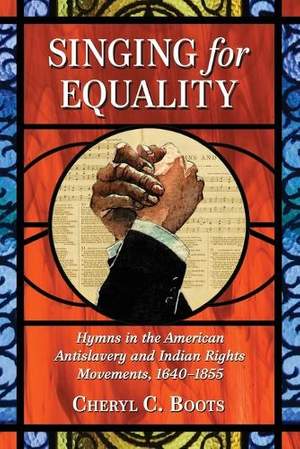
Singing for Equality: Hymns in the American Antislavery and Indian Rights Movements, 1640-1855
- Author: Boots, Cheryl C.
Book
$42.00Contents
- Table of Contents
- Acknowledgments ix
- Introduction: Recovering the Lost Soundtrack of American Social Visionaries 1
- 1. Seeing Children of God or Children of the Devil in Massachusetts Bay 11
- 2. Singing Nonconformist and Anglican Hymns in the 18th Century 26
- 3. Asserting Racial Equality with Sacred Verse in Early America 43
- 4. Debating Blacks’ and Indians’ Humanity in the Early Republic 66
- 5. Affirming the Humanity of Early-Antebellum Blacks and Indians 79
- 6. Making Space for Indians in Early Antebellum Fiction, or Not 103
- 7. Struggling to Enlist Support for the Cherokee People 132
- 8. Legitimating Black Emancipation with Blacks’ Voices 153
- 9. Singing Communities and the American Anti-Slavery Society 179
- 10. Making Space for Blacks in Late Antebellum American Fiction 203
- Conclusion: Tracing the Legacy of Sacred Music and American Racial Equality 234
- Appendix: Hymn Tunes Available Online 245
- Chapter Notes 247
- Bibliography 261
- Index 266