

In Flanders Fields Volume 93 - Flemish Baroque Treasures Unveiled
Utopia & Euterpe Baroque Consort, Bart Rodyns
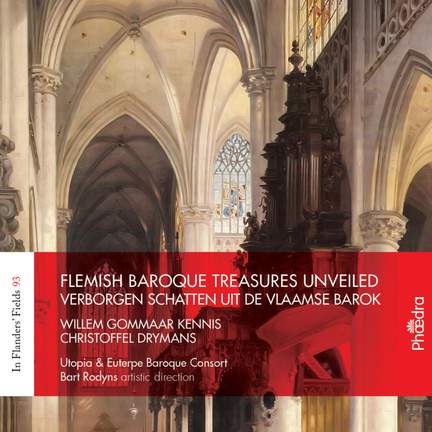
In Flanders Fields Volume 93 - Flemish Baroque Treasures Unveiled
Utopia & Euterpe Baroque Consort, Bart Rodyns
Purchase product

About
Willem Gommaar Kennis (1717–1789), already a violinist with the St Gummarus Church orchestra at age eleven, was appointed chapel master on 2 March 1742. The preserved appointment deed stipulated that he was expected to teach the choir boys to read and write, to attend church services on a regular basis, to compose music and leave it for free on the singers’ tribune.
There are only eight known vocal works, including a Magnificat, a Salve Regina and a Te Deum, which have now been recorded on CD for the first time. The works are kept in the archives of the Antwerp cathedral and come from the estate of Willem Jacobus Josephus Kennis (1768–1845), a son from Willem Gommaar’s second marriage. After he left Leuven, where he had succeeded his father as chapel master of the St Peter’s Church from 1789 to 1798, Willem became chapel master of Antwerp cathedral, where he served from 1803 to 1845.
Christoffel Drymans (1738–1797) studied at Leuven University and was ordained as a priest. On 3 June 1763, he was appointed chapel master. During his tenure in Lier (1763–1797), the music academy flourished and the music library collection expanded considerably with new works by local and international composers. Of Drymans himself, only six compositions are still held in the church’s archives, including Tria sunt, an anthem for the Office of the Dead (1780), the motet Dixit Dominus (1786) and the extensive Opusculum musicum novem lamentationum, a collection of works to texts of the Old Testament prophet Jeremiah for the Paschal Triduum (Holy Thursday, Good Friday and Holy Saturday).
Contents and tracklist
- Utopia, Euterpe Baroque Consort
- Bart Rodyns
- Lode Leire
- Utopia
- Bart Rodyns
- Martine Beernaert, Tine van Parys, Lode Leire
- Bart Rodyns
- Utopia, Euterpe Baroque Consort
- Bart Rodyns
- Martine Beernaert, Tine van Parys, Lode Leire
- Bart Rodyns
- Lode Leire
- Utopia
- Bart Rodyns
