

Help
Skip to main content

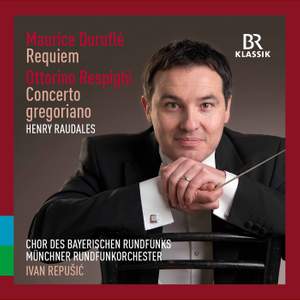
Duruflé: Requiem & Respighi: Concerto Gregoriano

Henry Raudale (organ), Okka von der Damerau (mezzo), Ljubomir Puškari (baritone), Max Hanf (cello)

Munchner Rundfunkorchester, Chor des Bayerischen Rundfunks, Ivan Repušić

Duruflé: Requiem & Respighi: Concerto Gregoriano

Duruflé: Requiem & Respighi: Concerto Gregoriano

Henry Raudale (organ), Okka von der Damerau (mezzo), Ljubomir Puškari (baritone), Max Hanf (cello)

Munchner Rundfunkorchester, Chor des Bayerischen Rundfunks, Ivan Repušić

Purchase product

CD

$18.75

This item is currently out of stock at the UK distributor. You may order it now but please be aware that it may be six weeks or more before it can be despatched.

Download

From$10.00

Download

Audio formats guide

48 kHz, 24 bit, FLAC/ALAC/WAV

$17.50

44.1 kHz, 16 bit, FLAC/ALAC/WAV

$13.00

320 kbps, MP3

$10.00

This release includes a digital booklet

Stream now Hi-RES 48 kHz, 24 bit

About

Ivan Repušić, the new chief conductor of the Munich Rundfunkorchester, devotes his first CD on BR-KLASSIK to works by the composers Maurice Duruflé and Ottorino Respighi, both of whom took a major interest in the melodies and harmonies of Gregorian chant. The French composer Duruflé’s “Requiem" is based on the Gregorian "Missa pro defunctis", the Latin Mass for the Dead, and the Italian Respighi, in his "Concerto Gregoriano", used Gregorian chant as a source of inspiration for the harmonious sound of the concerto and for the song-like treatment he gives to the solo violin. Maurice Duruflé's “Requiem” became especially well-known. Its first performance in 1947 was one of the high points of his career; the work not only helped to establish Duruflé as a successful composer but also brought him fame far beyond the borders of France. This self-contained, homogeneous and contemplative composition is based on themes from the Gregorian Mass for the Dead. In his work, Duruflé succeeded in fusing Gregorian chant, Baroque polyphony and colourful orchestration into a unified whole, and the spiritual, inward-looking character of the chants harmonises most effectively with the composer’s personal style. The impact of Gregorian chant on the composer Ottorino Respighi was “like an addiction”, and it had a vast influence on his work. Elements of it can be heard in almost all the works he composed after 1920. One reason why these puristic melodies, in conjunction with the harmony of the ecclesiastical modes, fascinated him so much was that they represented the greatest possible contrast to the overheated, chromatically refined harmonies of the Verists and the post-Wagnerians. Becoming increasingly atonal was never an option for Respighi; it was in the archaic and austere character of Gregorian chant, and in ancient melodies, that he recognised the greatest innovative potential.

Contents and tracklist

Requiem, Op. 9: Introit
Track length3:35
Requiem, Op. 9: Kyrie
Track length4:00
Requiem, Op. 9: Domine Jesu Christe
Track length8:16
Requiem, Op. 9: Sanctus
Track length3:23
Requiem, Op. 9: Pie Jesu
Track length3:22
Requiem, Op. 9: Agnus Dei
Track length4:03
Requiem, Op. 9: Lux aeterna
Track length4:05
Requiem, Op. 9: Libera me
Track length5:32
Requiem, Op. 9: In paradisum
Track length3:06
Concerto gregoriano, P. 135: I. Andante tranquillo - Allegro molto moderato - Calmo, tempo I
Track length9:18
Concerto gregoriano, P. 135: II. Andante espressivo e sostenuto
Track length10:40
Concerto gregoriano, P. 135: III. Finale. Allegro energico "Alleluja"
Track length12:42
View download progress