

Help
Skip to main content

US TARIFFS UPDATE | August 2025 | No impact expected on your Presto orders | Read full details

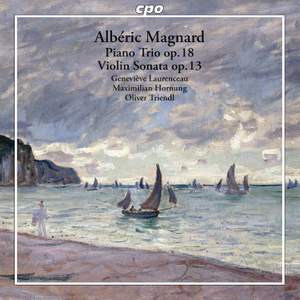
Magnard: Piano Trio in F Minor & Violin Sonata in G Major

Geneviève Laurenceau (violin), Maximilian Hornung (cello), Oliver Triendl (piano)

Magnard: Piano Trio in F Minor & Violin Sonata in G Major
The Trio, in fact, is the real revelation. It's superbly done, with an almost instinctive sense of interplay between the players, and a fine understanding of Magnard's emotional ambiguities...

Magnard: Piano Trio in F Minor & Violin Sonata in G Major

Geneviève Laurenceau (violin), Maximilian Hornung (cello), Oliver Triendl (piano)

Purchase product

CD

$13.00

Usually despatched in 3 - 4 working days

Download

From$10.00

Download

Audio formats guide

44.1 kHz, 16 bit, FLAC/ALAC/WAV

$13.00

320 kbps, MP3

$10.00

This release includes a digital booklet

Stream now lossless, 44.1 kHz, 16 bit
The Trio, in fact, is the real revelation. It's superbly done, with an almost instinctive sense of interplay between the players, and a fine understanding of Magnard's emotional ambiguities...

About

Magnard’s oeuvre is not very extensive, but some of his consistently innovative compositions number among the outstanding works of French music history. His chamber compositions are always in four movements, and this structural standard functions as a mark of his independence from the national practice (cf. the symphonies in three movements by Chausson or Dukas based on Franck’s model) and unwaveringly point to timeless models of German provenance.

Contents and tracklist

I. Sombre
Track length7:44
II. Chantant
Track length10:30
III. Vif. Tempo de valse
Track length5:06
IV. Largement - Vif
Track length13:33
I. Large
Track length11:55
II. Calme
Track length11:47
III. Très vif
Track length3:47
IV. Large
Track length13:26

Awards and reviews

November 2015

The Trio, in fact, is the real revelation. It's superbly done, with an almost instinctive sense of interplay between the players, and a fine understanding of Magnard's emotional ambiguities and his trenchant approach to form…it's all wonderfully taut, with austerely beautiful accounts of the first two movements and a nicely edgy approach ot the waltz that forms its third.
View download progress