

Help
Skip to main content

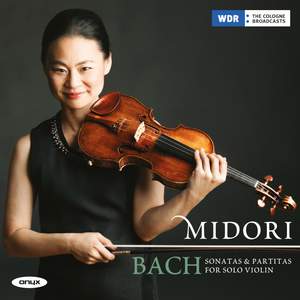
Bach, J S: Sonatas & Partitas for solo violin, BWV1001-1006

Midori (violin)

Bach, J S: Sonatas & Partitas for solo violin, BWV1001-1006
The Japanese violinist Midori offers a conservative performance avoiding anything which would be construed as controversial. Her tempos are moderate, her vibrato well controlled and her intonation...

Bach, J S: Sonatas & Partitas for solo violin, BWV1001-1006

Midori (violin)

Purchase product

2 CDs

$27.50

10+ available: usually despatched in 4 - 5 working days

Download

From$10.00

Download

Audio formats guide

44.1 kHz, 16 bit, FLAC/ALAC/WAV

$13.00

320 kbps, MP3

$10.00

This release includes a digital booklet

Stream now Hi-RES 48 kHz, 24 bit
The Japanese violinist Midori offers a conservative performance avoiding anything which would be construed as controversial. Her tempos are moderate, her vibrato well controlled and her intonation...

About

“The story goes that, when I was about two years old, my mother found me humming a Bach melody that she had been practicing a few days earlier. My own memories of Bach begin from the time when I started to practice my first solo Sonata in G minor, when I was about seven years old. The piece had been assigned to me, as all repertoire was at that age, and I had no idea what to do with it. Over the years, I have come to realize that, in studying Bach, one’s learning never stops. To my thinking – and I’m sure most other violinists would agree – these sonatas and partitas for solo violin are monuments of the literature, for many reasons. Their study opens up and trains the ear for more precise and ever-deeper listening. One learns to understand the relationship between the various notes, in addition to just hearing the notes themselves. Indeed, I find that I have learned more from studying these Bach compositions than from any other music. It is an almost miraculous feeling that envelops me when I am fully engaged with these musical masterworks.

These works are larger than life – they stretch the artistic and technical responses that one can have toward a piece of music. Bach’s music is always “right” for any circumstance. I have been able to present these pieces anywhere: to play for refugees in an outdoor setting, in the intensive care units at hospitals, in great concert halls, in places of worship, for celebratory occasions or remembrances and in any corner of any country in which I have ever performed. Bach travels well. The music does not require any special equipment or conditions. It must simply be played and heard, and invariably, with every committed performance, listeners young or old manage to be as transported as is any beguiled performer.” Taken from Midori’s booklet notes

Contents and tracklist

I. Adagio
Track length4:43
II. Fuga - Allegro
Track length4:45
III. Siciliana
Track length2:49
IV. Presto
Track length3:37
I. Allemanda
Track length5:25
II. Double
Track length2:46
III. Courante
Track length3:13
IV. Double: Presto
Track length3:32
V. Sarabande
Track length2:58
VI. Double
Track length2:25
VII. Tempo di Bourrée
Track length3:33
VIII. Double
Track length3:23
Sonata II BWV 1003 in A Minor: I. Grave
Track length4:57
II. Fuga
Track length7:18
III. Andante
Track length5:38
IV. Allegro
Track length5:48
I. Allemanda
Track length4:25
III. Sarabanda
Track length3:56
IV. Giga
Track length3:53
V. Ciaconna
Track length12:21
This track is only available as an album download.
I. Adagio
Track length4:34
II. Fuga
Track length9:40
III. Largo
Track length3:42
IV. Allegro assai
Track length5:20
I. Preludio
Track length3:38
II. Loure
Track length3:40
III. Gavotte en Rondeau
Track length3:13
IV. Menuet I - V. Menuet II
Track length4:29
VI. Bourrée
Track length1:34
VII. Gigue
Track length2:05

Awards and reviews

February 2016

The Japanese violinist Midori offers a conservative performance avoiding anything which would be construed as controversial. Her tempos are moderate, her vibrato well controlled and her intonation secure…the D minor Partita, with its great Chaconne, and the C major Sonata stand out for the lightly articulated and playful character of their dance movements

February 2016

Thomas Sanderling’s unhurried, solicitous conducting pays handsome long-term dividends … The recording finds an effective balance between voices and instruments, and moments of stage-shifting noise and the occasional audible prompt are only minimally distracting.
View download progress