

Help
Skip to main content

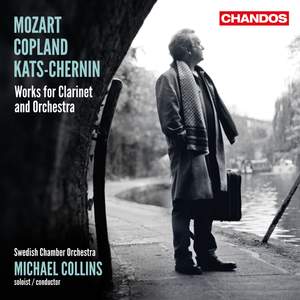
Mozart, Copland & Kats-Chernin: Works for Clarinet & Orchestra

Michael Collins (clarinet, basset clarinet & conductor), Michael Collins (basset clarinet)

Swedish Chamber Orchestra

Mozart, Copland & Kats-Chernin: Works for Clarinet & Orchestra
The limpid tone, the suave progress from note to note: such qualities make the Mozart Concerto's slow movement glide by in a dream...No kinks anywhere; but also few emotional markers. Cool perfection,...

Mozart, Copland & Kats-Chernin: Works for Clarinet & Orchestra

Michael Collins (clarinet, basset clarinet & conductor), Michael Collins (basset clarinet)

Swedish Chamber Orchestra

Purchase product

CD

$20.25

1 in stock: usually despatched within 1 working day

Download

From$10.00

Download

Audio formats guide

96 kHz, 24 bit, FLAC/ALAC/WAV

$15.50

44.1 kHz, 16 bit, FLAC/ALAC/WAV

$12.25

320 kbps, MP3

$10.00

This release includes a digital booklet

Stream now Hi-RES 96 kHz, 24 bit
The limpid tone, the suave progress from note to note: such qualities make the Mozart Concerto's slow movement glide by in a dream...No kinks anywhere; but also few emotional markers. Cool perfection,...

About

Michael Collins combines the roles of clarinet soloist and conductor as he leads the Swedish Chamber Orchestra in three works that chart the journey of the clarinet from Mozart’s late eighteenth-century Europe, via Aaron Copland’s 1940s America, to today’s classical scene with a piece written, for Michael Collins, in 2007 by the Australian composer Elena Kats-Chernin.

Mozart composed his Clarinet Concerto, just weeks before his death in 1791, for Anton Stadler, the first great clarinet virtuoso. Stadler performed the work on what today is known as the basset clarinet, which features additional low notes without compromising the higher register. Unfortunately, Mozart’s manuscript score has been lost. In recent years, however, editors and performers have made several attempts to determine Mozart’s original intentions, and the version recorded here represents one such reconstruction. The concerto has a quality of serene and resigned beauty, recognisable from Die Zauberflöte, and from Mozart’s Requiem.

Aaron Copland’s Clarinet Concerto was commissioned in 1947 by Benny Goodman, the most famous band leader of the swing era, who has been credited with having made jazz ‘respectable’. Goodman also had a second career as a classical clarinettist. He was eager to enrich the repertoire by inviting major composers to write for him, and Copland was happy to take on the challenge.

Elena Kats-Chernin is one of Australia’s leading composers. Her Ornamental Air was written in 2007 in response to a commission from a group of orchestras including the Swedish Chamber Orchestra, with Michael Collins as the intended soloist. The score is modelled closely on the Clarinet Concerto by Mozart. Not only are the orchestral forces identical – two flutes, two bassoons, two horns, and strings – but the solo instrument is the basset clarinet, for which Mozart also wrote his concerto. Kats-Chernin’s writing here takes full advantage of the exceptionally wide range of the instrument, as well as its potential for both virtuosity and lyricism.

Contents and tracklist

I. Allegro
Track length12:03
II. Adagio
Track length7:18
III. Rondo. Allegro
Track length8:27
I. Slowly and expressively
Track length8:34
II. Rather fast
Track length7:56
I. Crotchet = 192 - 200
Track length10:15
II. Minim = 80 (or slower)
Track length6:24
III. Crotchet = 144
Track length5:25

Spotlight on this release

  • Aaron Copland

    9th Jan 2015by James Longstaffe

    James selects some of his favourite recordings of the music of the quintessentially American composer, Aaron Copland.

Awards and reviews

March 2013

The limpid tone, the suave progress from note to note: such qualities make the Mozart Concerto's slow movement glide by in a dream...No kinks anywhere; but also few emotional markers. Cool perfection, that's the tendency.

January 2015

Michael Collins directs the Swedish Chamber Orchestra from the clarinet in this beautifully expressive recording. The first movement in particular is ravishingly lyrical, and there's some incisive, rhythmic playing in the second movement.
View download progress