


US TARIFFS UPDATE | August 2025 | No impact expected on your Presto orders | Read full details
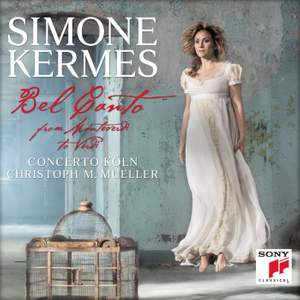
Bel Canto from Monteverdi to Verdi
Simone Kermes (soprano)
Concerto Köln, Christoph-Mathias Mueller
Awards:
-
Gramophone Awards, 2014, Shortlisted - Recital
The programme is expressly devised so that Kermes can shed new light on 19th-century vocal writing, applying the stylistic approaches she has developed in music of earlier eras: her trademark...
Bel Canto from Monteverdi to Verdi
Simone Kermes (soprano)
Concerto Köln, Christoph-Mathias Mueller
Purchase product
Awards:
-
Gramophone Awards, 2014, Shortlisted - Recital
The programme is expressly devised so that Kermes can shed new light on 19th-century vocal writing, applying the stylistic approaches she has developed in music of earlier eras: her trademark...
About
With her new album Simone Kermes presents her dedication to bel canto. Despite the title the Baroque soprano hasn’t suddenly switched from one voice type to another but is simply following her own interpretation of this term, arguing that bel canto is “inconceivable without reference to the Baroque tradition”.
The album centres around famous arias of the belcanto soprano repertoire: “Casta Diva“ from Bellini’s Norma, “O luce di quest’ anima“ from Donizetti’s Linda di Chamounix and “Dolce pensiero“ from Rossini’s Semiramide.
The programme also features a number of rarely performed works: Airas of Mercadantes “Virginia“, Rossini’s “Maometto Secondo“, Donizetti’s “Betly“ or Bellini’s “Adelson e Salvini“. As a connecting link between baroque and bel canto Kermes added the two arias of the Queen of Night from Mozart’s Magic Flute. Simone Kermes is accompanied by Concerto Cöln, performing on period instruments.
Simone Kermes has received a number of international awards for her solo albums, such as the annual prize of the Deutsche Schallplattenkritik, the Diapason d`Or, Midem Award, Choc Le Monde de la Musique, Gramophone magazine’s Disc of the Month and the Echo Prize. For her CD entitled Colori d`amore she was the winner of the Echo Prize in the highest category, Female Singer of the Year, in 2011. In 2012 the Munich Abendzeitung awarded Simone Kermes its Star of the Year Award, and in April 2013 she received one of Russia’s highest cultural awards, the Golden Mask, for her performances as Fiordiligi in Mozart’s Così fan tutte at the Tchaikovsky State Academic Theatre in Perm.
Contents and tracklist
- Simone Kermes
- Concerto Köln
- Christoph M. Mueller, Christoph-Mathias Mueller
- Simone Kermes
- Concerto Köln
- Christoph M. Mueller, Christoph-Mathias Mueller
- Simone Kermes
- Concerto Köln
- Christoph M. Mueller, Christoph-Mathias Mueller
- Simone Kermes (soprano)
- Concerto Köln
- Christoph-Mathias Mueller
- Simone Kermes (soprano), Martin Sandhoff (flute)
- Concerto Köln
- Christoph-Mathias Mueller
- Simone Kermes
- Concerto Köln
- Christoph M. Mueller, Christoph-Mathias Mueller
- Simone Kermes
- Concerto Köln
- Christoph M. Mueller, Christoph-Mathias Mueller
- Simone Kermes
- Concerto Köln
- Christoph M. Mueller, Christoph-Mathias Mueller
- Simone Kermes
- Concerto Köln
- Christoph M. Mueller, Christoph-Mathias Mueller
- Simone Kermes
- Concerto Köln
- Christoph M. Mueller, Christoph-Mathias Mueller
- Simone Kermes (soprano)
- Concerto Köln
- Christoph-Mathias Mueller
- Simone Kermes, Gabriele Palomba (lute)

Awards and reviews
February 2014
The programme is expressly devised so that Kermes can shed new light on 19th-century vocal writing, applying the stylistic approaches she has developed in music of earlier eras: her trademark blend of dazzling technical accomplishment, vital imagination, care over detail and a willingness to take risks...an unconventional but special addition to any Italian opera collection.
February 2014
What can she bring to this repertoire? As you would expect, she's good at 'the runs' and the high notes. However, she simply doesn't have the weight or dark colour to frighten us...or inspire us...The final Monteverdi item is heavenly, both in itself and in reminding us how strong Kermes is on home turf.
24th November 2013
spiffing accounts of both of Mozart’s Queen of Night arias. The soprano’s Norma (Casta diva) sounds impossibly girlish, but arias from Rossini’s Semiramide and Maometto Secondo, and Donizetti’s Linda di Chamounix and Betly, are dazzlingly sung. Odabella’s Santo di patria (from Verdi’s Attila) is barnstorming.