Help
Skip to main content

US TARIFFS UPDATE | August 2025 | No impact expected on your Presto orders | Read full details

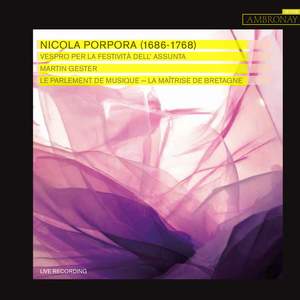
Porpora: Vespro per la Festività dell'Assunta

Marilia Vargas, Michiko Takahashi (sopranos) & Delphine Galou (alto)

Le Parlement de Musique & La Maîtrise de Bretagne, Martin Gester (direction)

Porpora: Vespro per la Festività dell'Assunta
Markstrom's detective work makes an entire reconstruction possible but for this live recording makes no claims for liturgical observance or historical completeness...Le Parlement de Musique...

Porpora: Vespro per la Festività dell'Assunta

Marilia Vargas, Michiko Takahashi (sopranos) & Delphine Galou (alto)

Le Parlement de Musique & La Maîtrise de Bretagne, Martin Gester (direction)

Purchase product

48 kHz, 24 bit, FLAC/ALAC/WAV

$15.00

44.1 kHz, 16 bit, FLAC/ALAC/WAV

$12.50

320 kbps, MP3

$10.00

This release includes a digital booklet

Markstrom's detective work makes an entire reconstruction possible but for this live recording makes no claims for liturgical observance or historical completeness...Le Parlement de Musique...

About

Porpora's 'Vespers' was first performed in Venice at the Ospedaletto, one of four orphanages for girls that specialised in music to the extent that they were regarded as conservatories. The most famous of the four was the Pietà, where Vivaldi taught violin. The Vespers 1744 consists of five psalms, a Magnificat and a Salve Regina. Four of the pieces can be found in autograph manuscripts in the British Library, including three of the five great psalms: the Laetatus sum and Nisi Dominus in Additional 13126 and the Lauda Jerusalem in Additional 1412, all three dated 1744. Another of the Porpora manuscripts in the British Library, Additional 14125, contains two Salve Reginas dated 1744; the one designated ‘Per Angiola Moro’ has been chosen for the Vespers 1744 because of its beauty. The music is conceived in the early Classical style as developed during the 1720s by Porpora and his rivals, Leonardo Vinci and Johann Adolph Hasse. The music is characterised by its ornate periodic melodies which later became exemplified in the church music of Mozart. Maestro Porpora of the Ospedaletto would later become a character in George Sand’s novel 'Consuelo', with the heroine a composite of Angiola Moro and Porpora’s most famous pupil ‘La Mingotti’. In this transformation from fashionable opera composer to revered maestro di cappella and teacher, the Vespers of 1744 probably played a pivotal role, somewhat akin to the contemporary 'Messiah' or 'Samson' in Handel’s ‘conversion’ to oratorio. For several years now Le Parlement de Musique has pursued its investigation of the concertante repertoire of the Venetian ospedali: after Bassani, Vivaldi, Hasse, Jommelli and Latilla, the spotlight is now on Nicola Porpora and his concertato Vespers for female voices and orchestra of the Ospedaletto.

Contents and tracklist

I. Laudate pueri Dominum (Vivace)
Track length2:42
II. A solis ortu (Larghetto)
Track length4:01
III. Quis sicut Dominus (Allegro)
Track length3:41
IV. Qui habitare (Moderato)
Track length5:17
V. Gloria (Allegro)
Track length3:36
I. Salve Regina (Adagio)
Track length4:34
II. Ad te clamamus (Allegretto)
Track length1:10
III. Ad te suspiramus (Adagio)
Track length2:56
IV. Eia ergo (Allegro)
Track length1:14
V. Illos tuos misericordes (Adagio)
Track length2:36
VI. O clemens (Affettuoso)
Track length2:54
I. Laetatus sum
Track length5:18
II. Quia illic sederunt
Track length4:18
III. Fiat pax
Track length1:44
IV. Gloria
Track length3:27
V. Sicut erat
Track length2:57
I. Lauda Jerusalem
Track length6:50
II. Gloria
Track length1:34
III. Sicut erat
Track length3:04

Awards and reviews

July 2012

Markstrom's detective work makes an entire reconstruction possible but for this live recording makes no claims for liturgical observance or historical completeness...Le Parlement de Musique provide lean accompaniments; and the all-girl choir Maitrise de Bretagne sings with unaffected directness. Not really a proper Vespers but an enjoyable concert.

May 2012

The all-female choir on this recording, La Maitrise de Bretagne, sounds absolutely splendid and perfectly natural - the absence of deeper voices is scarcely noticeable after the first minute or two...The three solo singers, two sopranos and one contralto, acquit themselves well in Porpora's very florid writing...All in all, this is a fascinating and highly enjoyable project.

November 2012

I have nothing but admiration for the performances of the three singers … They have very fine and agile voices, and are meeting the high requirements of this music with impressive ease.
View download progress