
US TARIFFS UPDATE | August 2025 | No impact expected on your Presto orders | Read full details
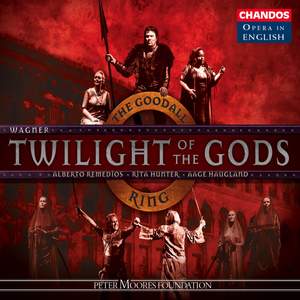
Special offer. Wagner: Twilight of the Gods
Alberto Remedios (Siegfried), Rita Hunter (Brünnhilde), Aage Haugland (Hagen), Derek Hammond-Stroud (Alberich), Norman Welsby (Gunther), Margaret Curphey (Gutrune), Katherine Pring (Waltraute); English National Opera, Reginald Goodall
Valkyrie: There's something inevitable, even eternal about Goodall's long-breathed, fulltoned, often ideally articulated reading. The ENO management's faith in him was handsomely repaid in his...
Special offer. Wagner: Twilight of the Gods
Alberto Remedios (Siegfried), Rita Hunter (Brünnhilde), Aage Haugland (Hagen), Derek Hammond-Stroud (Alberich), Norman Welsby (Gunther), Margaret Curphey (Gutrune), Katherine Pring (Waltraute); English National Opera, Reginald Goodall
Purchase product
Valkyrie: There's something inevitable, even eternal about Goodall's long-breathed, fulltoned, often ideally articulated reading. The ENO management's faith in him was handsomely repaid in his...
About
Contents and tracklist
- Aage Haugland (bass), Valerie Masterson (soprano), Rita Hunter (soprano), Anne Collins (contralto), Helen Attfield (contralto), Shelagh Squires (mezzo-soprano), Alberto Remedios (tenor), Norman Welsby (baritone), Gillian Knight (mezzo-soprano), Margaret Curphey (soprano), Anne Evans (soprano), Derek Hammond-Stroud (baritone), Katherine Pring (mezzo-soprano)
- English National Opera Chorus, English National Opera
- Sir Reginald Goodall
Act II Scene 4: I greet you, noble friend (Gunther, Vassals, Siegfried, Brunnhilde, Hagen)
Track length4:50
Act II Scene 4: Ha! - Siegfried stole it (Brunnhilde, Siegfried, Hagen, Gutrune, Vassals, Women)
Track length2:22
Act II Scene 4: Here in Walhall, mighty immortals! (Brunnhilde, Gunther, Women, Vassals)
Track length3:26
Act II Scene 4: Would you defile your name so lightly? (Siegfried, Brunnhilde, Vassals, Women, Gunther, Gutrune, Hagen)
Track length4:08
Act III Scene 1: Fair sunlight, shine on us in splendour (Woglinde, Wellgunde, Flosshilde)
Track length2:23
Act III Scene 1: Fair sunlight, send to us the hero (Woglinde, Wellgunde, Flosshilde)
Track length2:07
Act III Scene 1: A goblin led me astray (Siegfried, Woglinde, Wellgunde, Flosshilde)
Track length1:45
Act III Scene 1: Siegfried, if we find your bear (Woglinde, Siegfried, Wellgunde, Flosshilde)
Track length2:52
Act III Scene 1: Why should I let them laugh and jeer? (Siegfried, Flosshilde, Woglinde, Wellgunde)
Track length1:46
Act III Scene 1: Siegfried! … Evil lies in that ring (Woglinde, Wellgunde, Flosshilde, Siegfried)
Track length2:32
Act III Scene 1: Siegfried! … Give heed to our words (Woglinde, Wellgunde, Flosshilde, Siegfried)
Track length2:49
Act III Scene 1: Come, sisters! Flee from this madman! (Woglinde, Wellgunde, Flosshilde, Siegfried)
Track length4:20
Act III Scene 2: In grief I watched the branches above (Siegfried, Hagen, Gunther, Vassals)
Track length6:00
Act III Scene 3: Sturdy branches, building his pyre (Brunnhilde), "Brunnhilde's Immolation"
Track length2:57
Awards and reviews
2010
Valkyrie: There's something inevitable, even eternal about Goodall's long-breathed, fulltoned, often ideally articulated reading. The ENO management's faith in him was handsomely repaid in his ability to convey his lifetime vision to is regular cast and eventually to his audiences. On paper, tempos may look unacceptably slow; in practice there are very few places – perhaps Siegmund's Spring song and Sieglinde's reply – where they seem too tardy.
That's largely due to his ability to find the Hauptstimme for every paragraph of the music, indeed for a whole act and, perhaps even more, to his ability to persuade players and singers alike to sustain a long line. Listeners familiar only with the Solti cycle will hardly recognise this as the same work.
By 1976 all his singers were entirely inside their respective roles and so able to project a feeling of familiarity with their music that's evident in every bar. Like all the most satisfying sets of the Ring, it benefits enormously from being heard live in a theatre acoustic, and here no compromises have to be made, so superb are producer John Mordler's and his team's skills.
You seem to be seated in centre stalls imbibing the performance. Rita Hunter bestrides the role of Brünnhilde in a confident manner achieved in relatively modern times only by Birgit Nilsson, whose bright tone and effortless top Hunter's so much resembles. She's also a thoughtful, very human interpreter of the role, keen with her words and investing them with the right import.
By her side Bailey confirms that he's as excellent a Wotan as any since Hans Hotter. His reading of the taxing part is virtually tireless and his interpretation combines authority with fatherly concern. Remedios's Siegmund remains one of the most sweetly sung and appealing on disc. If Curphey isn't quite in his class vocally, she offers a deeply felt and sympathetic Sieglinde. Ann Howard is, rightly, a termagant of a Fricka, with a touch of asperity in her tone. Clifford Grant is a sonorous, towering Hunding. The Valkyries, comprising many of the most promising female singers of the day (among them Elizabeth Connell and Anne Evans), acquit themselves very well. All the cast benefit from Andrew Porter's carefully wrought, very singable translation.
Overall, a hearty welcome back to a great recording.
Siegfried: That Reginald Goodall idolised Klemperer and Knappertsbusch is evident in every aspect of this weighty, consistently thought-through interpretation; indeed it consoles us for the cycle Klemperer never recorded.
The performance is also a reminder of what those then in charge of the ENO – Stephen Arlen, Lord Harewood and Edmund Tracey – had the sense to realise: that here was a unique opportunity to let a seasoned Wagnerian have his head in terms of the time and trouble to prepare a cycle in his own long time-scale. The results are there for all to hear in the total involvement of every member of the orchestra, the lyrical lines of the singers, the superb enunciation of the faultless translation.
Remedios's fresh, lyrical singing is a joy from start to finish; nobody since has equalled him as Siegfried. Dempsey's Mime is at once subtle, funny yet menacing. Those who so praise Tomlinson as Wotan/Wanderer can't have heard Bailey's better sung, articulate and eloquent assumption, another reading not since surpassed.
To crown the performance we have Rita Hunter's glorious Brünnhilde, so luminously and keenly sung, just about on a par with Nilsson in the role. They are all wonderfully supported by Goodall and his players. Only in some of Siegfried's Act 1 forging and his struggle with Fafner might one ask for a shade more physical energy, but that's a small price to pay for such understanding of Wagnerian structure. Rhinegold and Twilight of the Gods : After more than 25 years, these recordings remain gripping for reasons similar to those applying to the other sections of the English Ring reissued by Chandos. In spite of speeds that in other hands would seem often unreasonably slow, or to an extent because of them, Goodall's interpretation has an unerring sense of lyrical and dramatic concentration, every paragraph, phrase and bar carefully considered and executed with loving care by singers and players alike, all so closely coached by their veteran conductor. Above all there's the refined legato observed by all the singers. And the sense of real-life occasion, the theatre's acoustic clearly felt throughout. Andrew Porter's wonderfully lucid translation is given its full due by all the soloists, who once more sound an utterly convincing team. In Rhinegold the main honours are carried off by Emile Belcourt's plausible, witty and articulate Loge, Hammond-Stroud's imposing, strongly sung Alberich, Robert Lloyd's sympathetic Fasolt and Bailey's everauthoritative Wotan. With a pleasing trio of Rhinemaidens headed by Masterson's gleaming Woglinde, Clifford Grant's gloomy, louring Fafner and Anne Collins's deep-throated Erda, the strength of the ENO roster at the time is there for all to hear. In Twilight, Hunter and Remedios excel themselves as a more heroic than tragic pair, their singing steady, keen with words and very much in character following so many performances, by 1977, of the complete cycle. The recently departed Aage Haugland offers a welcome souvenir of his career as a louring Hagen. Welsby uncovers the right touches of weak will for Gunther while Curphey is suitably alluring as sister Gutrune. Pring offers an appropriately urgent and strongly sung Waltraute.
The Norns could hardly be more strongly cast.
By and large, the playing of the ENO Orchestra is of an equally consistent nature, responding to Goodall's long-breathed conducting with playing of beauty and strength adding up to a formidable traversal of the score. The recording, masterminded by John Mordler, need not fear comparison with anything more recent.
Indeed the absence of unwanted reverberation and excessive sound effects is most welcome.
What we get is the music unvarnished and truthful, for which many thanks again to the foresight of the ENO directors of the day and to Peter Moores for providing the wherewithal to execute it. Anyone wanting the work in the vernacular, who hasn't already acquired it in its previous incarnations, need not hesitate.