
US TARIFFS UPDATE | August 2025 | No impact expected on your Presto orders | Read full details
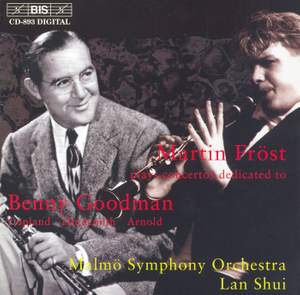
Clarinet Concertos dedicated to Benny Goodman
Martin Fröst (clarinet)
Malmö Symphony Orchestra, Lan Shui
All three of these concertos were written for Benny Goodman, but, not surprisingly, it's the Arnold work which most fully exploits his dedicatee's jazz background. The first movement is a typical...
Clarinet Concertos dedicated to Benny Goodman
Martin Fröst (clarinet)
Malmö Symphony Orchestra, Lan Shui
Purchase product
All three of these concertos were written for Benny Goodman, but, not surprisingly, it's the Arnold work which most fully exploits his dedicatee's jazz background. The first movement is a typical...
About
Contents and tracklist
Work length18:19
I. Slowly and Expressively
Track length9:49
II. Rather Fast
Track length8:30
Work length24:30
I. Rather Fast
Track length8:06
II. Ostinato
Track length2:10
III. Quiet
Track length7:55
IV. Gay
Track length6:19
Work length15:16
I. Allegro vivace
Track length5:32
II. Lento
Track length7:19
III. The Pre-Goodman Rag. Allegro non troppo
Track length2:25
Awards and reviews
2010
All three of these concertos were written for Benny Goodman, but, not surprisingly, it's the Arnold work which most fully exploits his dedicatee's jazz background. The first movement is a typical Arnoldian scherzando, with an irrepressible Tam O'Shanter/Beckus the Dandipratt audacity.
Fröst and Lan Shui clearly relish its verve and energy, and then bring a seductive richness to the main theme of the slow movement. Yet they don't miss the plangent emotional ambivalence later, for there are characteristic moments of Arnoldlike darkness here too. The outrageous showstopper finale, with its rooty-tooty clarinet tune and orchestral whoops, also has a surprise up its sleeve in its sudden lyrical interlude; but one and all let their hair down for the boisterous reprise.
At the haunting opening of the Copland concerto, Martin Fröst's clarinet steals in magically on a half-tone. Lan Shui's sympathetic and flexible support contributes to a memorable performance of Copland's masterly first movement, with the coda gently fading into the cadenza.
The Hindemith concerto which follows produces a characteristic sinewy lyricism in the first of its four movements, with some nicely touched-in brass and woodwind comments.
Again Fröst cajoles the ear with his pliable line and the effect is unexpectedly mellow. With extremely fine recording and marvellous solo playing, this triptych will be hard to surpass.