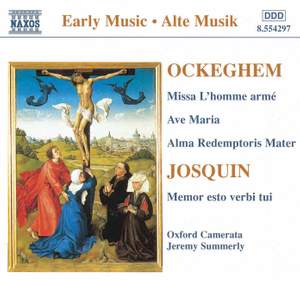


Special offer. Ockeghem: Missa L'homme Armé
Oxford Camerata, Jeremy Summerly
Awards:
-
Penguin Guide, Rosette
The centrepiece here is Ockeghem's L'homme armé Mass. It may be one of his earliest Masses, dating perhaps from the early 1450s. It's also one of his most curious. For the most part it lies...
Special offer. Ockeghem: Missa L'homme Armé
Oxford Camerata, Jeremy Summerly
Purchase product
Awards:
-
Penguin Guide, Rosette
The centrepiece here is Ockeghem's L'homme armé Mass. It may be one of his earliest Masses, dating perhaps from the early 1450s. It's also one of his most curious. For the most part it lies...
About
Contents and tracklist
Awards and reviews
-
Penguin GuideRosette
2010
The centrepiece here is Ockeghem's L'homme armé Mass. It may be one of his earliest Masses, dating perhaps from the early 1450s. It's also one of his most curious. For the most part it lies in a relatively high register, belying his usual predilection for low bass ranges; but every now and again the basses descend in spectacular fashion. In the third Agnus they hold down the tune in very long notes, while the other voices seem to float above them. Seldom before in the history of music can the articulation of time have been so clear a feature of a piece's design: it seems almost to have been suspended altogether. It's an extraordinary moment, difficult to pull off in performance, but here the singers seem to have got it right. Elsewhere, Summerly's approach is nicely varied, but on the whole more meditative than emphatic. The performance grows in stature with each movement, as though keeping pace with the cycle's ambition. The reading isn't without the odd glitch, but taken as a whole it's a fine achievement. The accompanying motets work very well, but it's a shame that the choir's richness of sound isn't quite matched by the acoustic. But the overall impression is resoundingly positive: those new to Ockeghem should find this disc too good an opportunity to pass up.
2011 edition
[L'Homme arme] is superbly sung here and is marvellously paced...the recording, made in the Chapel of Hertford College, Oxford, could hardly be bettered.