Help
Skip to main content

US TARIFFS UPDATE | August 2025 | No impact expected on your Presto orders | Read full details

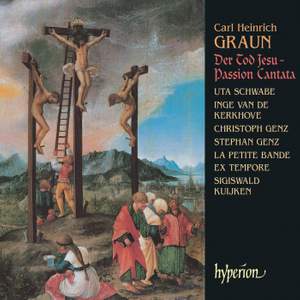
Graun, C H: Der Tod Jesu - Passion Cantata

Uta Schwabe (soprano), Ingevan de Kerkhove (soprano), Christoph Genz (tenor), Stephan Genz (baritone)

La Petite Bande, Ex Tempore, Sigiswald Kuijken

Graun, C H: Der Tod Jesu - Passion Cantata

Graun, C H: Der Tod Jesu - Passion Cantata

Uta Schwabe (soprano), Ingevan de Kerkhove (soprano), Christoph Genz (tenor), Stephan Genz (baritone)

La Petite Bande, Ex Tempore, Sigiswald Kuijken

Purchase product

2 CDs

$17.50

In stock - only 81 left: usually despatched within 1 working day

Download

From$9.25

Download

Audio formats guide

44.1 kHz, 16 bit, FLAC/ALAC/WAV

$13.75

320 kbps, MP3

$9.25

This release includes a digital booklet

Stream now lossless, 44.1 kHz, 16 bit

About

During his lifetime, Carl Heinrich Graun, a younger contemporary of Bachs, was one of the best-known exponents of Italian opera in Germany. He achieved a reputation as a skilled composer, rising to the position of vice-Kapellmeister in Braunschweig. In time, King Frederick II, The Great, appointed Graun his court Kapellmeister. Graun became a leading figure in the renowned Berlin school that developed at Frederick the Greats court, a school which also included his brother Johann Gottlieb, Kirnberger, Quantz, Benda and Carl Philipp Emmanuel Bach. Graun became most famous for his religious music, and above all for his Der Tod Jesu. Der Tod Jesu forms part of the long Christian tradition of musical settings of the Passion story for the period before Easter. The text, compiled from the Gospels by Carl Wilhelm Ramler, was almost simultaneously set to music by Graun and Telemann, the two works receiving their premieres in March 1755. The stylistic differences of the two works are striking. Telemann represents the North-German, late-Baroque tradition, with all its complexity and preference for structure and colour. Graun, influenced by Italian opera, chose the path of lyricism and spontaneous melodies, using the harmonic language that had emerged from Classicism. In Der Tod Jesu we find fugal passages reminiscent of Bach; if a feeling of timelessness, an expression of higher things, is characteristic of Bachs works, here personal expression gains the upper hand in a freer style. The text includes no dialogues or dramatic personages such as an evangelist-narrator or soloists with assigned roles. Rather, the soloists alternate (also exceptionally joining for duets) to present a free version of an episode from the Passion story in a recitative, followed by a poetic reflection on these events in an aria. After one or two of these individual interventions, the choir makes its answer, crowned by a chorale that could be sung by the whole congregation. The central position of the chorales was an important factor in the success of the work. Der Tod Jesu was so well received that it was performed again the following year on Good Friday, a tradition that was then maintained at the Berlin court until 1884. We are left only to wonder why Der Tod Jesu disappeared from the repertoire at the end of the nineteenth century. The appeal of the rediscovered Bach Passions perhaps proved impossible to counter.

Contents and tracklist

No 01. Choral. Du, dessen Augen flossen
Track length1:23
No 02. Tutti. Sein Odem ist schwach
Track length3:47
No 03. Recitative. Gethsemane! Gethsemane!
Track length2:44
No 04. Aria. Du Held, auf den die Köcher
Track length7:57
No 05. Choral. Wen hab' ich sonst als dich allein
Track length1:24
No 06. Recitative. Ach mein Immanuel!
Track length2:25
No 07. Aria. Ein Gebeth um neue Stärke
Track length8:22
No 08. Recitative. Nun klingen Waffen
Track length2:27
No 09. Aria. Ihr weichgeschaffnen Seelen
Track length9:23
No 10. Tutti. Unsre Seele ist gebeuget zu der Erden
Track length3:58
No 11. Choral. Ich will von meiner Missethat
Track length1:12
No 12. Recitative. Jerusalem voll Mordlust ruft
Track length3:48
No 13. Aria. So stehet ein Berg Gottes
Track length6:52
No 14. Tutti. Christus hat uns ein Vorbild gelassen
Track length3:06
No 15. Choral. Ihr werde Dir zu Ehren alles wagen
Track length0:52
No 16. Recitative. Da steht der traurige, verhängnisvolle Pfahl
Track length2:35
No 17. Duetto. Feinde, die ihr mich betrübt
Track length9:06
No 18. Recitative. Wer ist der Heilige
Track length2:10
No 19. Aria. Singt dem göttlichen Propheten
Track length6:17
No 20. Tutti. Freuet euch alle Ihr Frommen
Track length2:42
No 21. Choral. Wie herrlich ist die neue Welt
Track length1:32
No 22. Recitative. Auf einmal fällt der aufgehaltne Schmerz
Track length2:25
No 23. Accompagnement. Es steigen Seraphim von allen Sternen nieder
Track length2:56
No 24. Choral. Ihr Augen, weint!
Track length4:44
No 25. Chor. Hier liegen wir
Track length6:53
View download progress