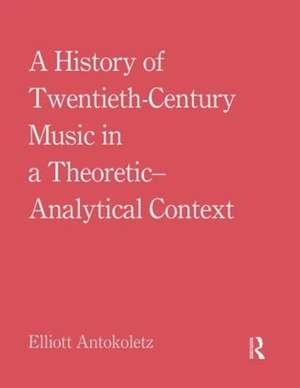
A History of Twentieth-Century Music in a Theoretic-Analytical Context
- Author: Antokoletz, Elliott
With this book, Antokoletz (Univ. of Texas, Austin) aims to provide a more in-depth application of musical analysis to 20th-century music than afforded by other current music histories...Advanced... — More…
Book
$286.50Printed on demand
Other available formats
-
PaperbackBook: $72.75
Contents
- Part 1 : Music to the Late 1940s
- 1. The Vienna of Freud: Toward Expressionism and the transformation of chromatic tonality
- 2. Vienna Schoenberg circle: Expressionism and free atonality
- 3. Schoenberg's music societies, World War I, and evolution of the twelve-tone method
- 4. Musical reactions to the ultrachromaticism of the Wagner-Strauss period: Rise of national styles
- 5. Toward synthesis of divergent folk- and art-music sources in Eastern Europe
- 6. Cultural identity and cosmopolitan developments in European music
- 7. New musical sources and aesthetics in the United States
- 8. Search for cultural identity in Latin America
- 9. Rise of neoclassicism in France: The Cocteau-Satie era and "Les Six"
- 10. Stravinsky in Switzerland and Paris (1914-1939): The neoclassical style
- 11. Neotonality and Gebrauchsmusik in Germany
- 12. The music of Soviet composers
- 13. Color, noise, and new sonorities
- 14. Early developments of the twelve-tone system beyond Schoenberg, Berg, and Webern
- Part 2 : Music Since the Mid 1940s
- 15. Total serialization in Europe
- 16. Varied approaches to the twelve-tone principle and rhythmic formulization in the United States
- 17. Twelve-tone tonality
- 18. Musique concrete and electronic music
- 19. Aleatory-Chance, improvisation, open form-and Minimalist Music
- 20. Synthesis of national and other earlier trends in Europe
- 21. Synthesis of national and other earlier trends in the United States
- 22. Latin American Composers at home and abroad: Synthesis of national and other earlier trends
- 23. Synthesis of East and West in Eastern Asia