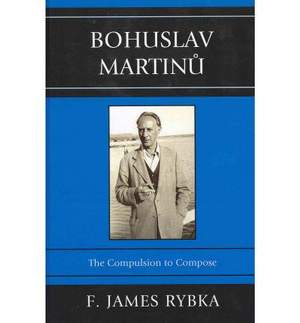
Bohemian composer Bohuslav Martinu (1890-1959) was exceptionally prolific, composing over 400 imaginative, well-crafted, and diverse pieces, including symphonies, operas, ballet scores, and other orchestral works. For 12 years (1941-1953), he lived in America, during which he enjoyed a brilliant reputation, and his works were played by nearly all the major orchestras. Yet today, his works are rarely performed. In Bohuslav Martinu: The Compulsion to Compose, F. James Rybka provides a documented explanation for Martinu's amazing output: he had Asperger syndrome. Indeed, Martinu is believed to be the first composer ever to be documented, albeit retrospectively, with an autistic spectrum disorder. In this unique biography, Rybka follows Martinu's life from his birth in Policka, Bohemia to his composition studies with Albert Roussel, his escape from Nazis, and his rise as an internationally recognized composer with premieres of his works in Boston, Prague, London, and Basel. As Rybka explains how the dynamics of Asperger Syndrome affected the composer's work, readers will more fully appreciate Martinu's accomplishments and legacy. Containing important letters and photographs, this book will inspire and inform those impacted by autism but will also be of interest to music scholars and students alike.